
Hajar Farouq Salloum
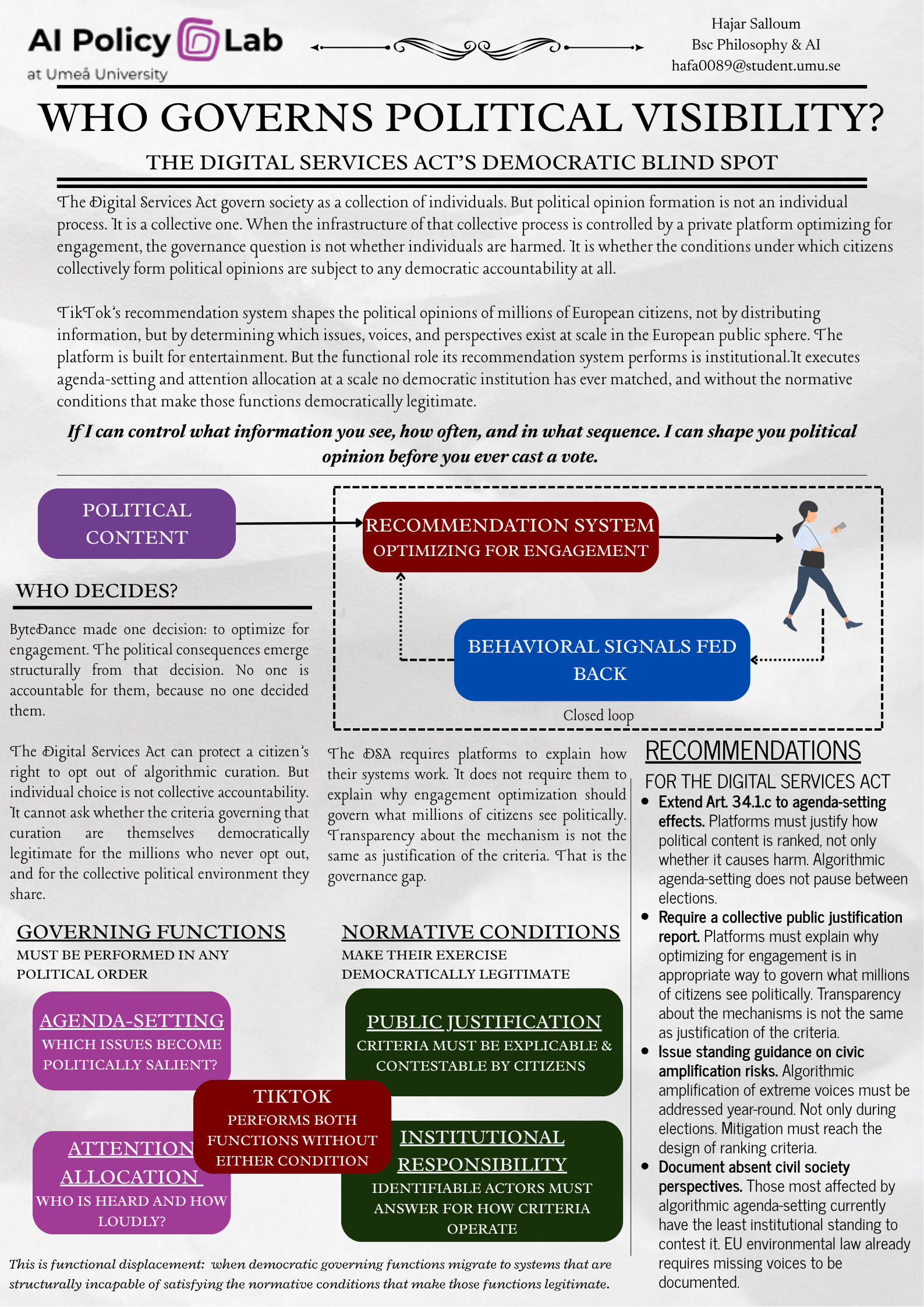
Topic: Who Governs Political Visibility? The DSA’s Democratic Blind Spot In Recommender System Governance.
Objective: To critically examine how algorithmic information flows may influence cognitive autonomy and the conditions for democratic deliberation. The project draws on Habermas’s theory of deliberative democracy and philosophical accounts of autonomy to identify when and how recommendation systems may support or undermine democratic reasoning. It reviews current policy frameworks, including the EU AI Act and Digital Services Act, to assess how autonomy and deliberative integrity are protected, and conducts interviews with citizens to explore their lived experience of algorithmic mediation and information overload.
Outcome: A policy brief and a conceptual framework identifying ways to preserve cognitive autonomy in AI-mediated information environments.
Executive Summary: The Digital Services Act (DSA) governs society as a collection of individuals. But political opinion formation is not an individual process, it is a collective one. When the infrastructure of that collective process is controlled by a private platform optimizing for engagement, the governance question is not whether individuals are harmed. Who gave TikTok that authority? No one. That is the problem.
TikTok’s recommendation system shapes the political opinions of millions of European citizens, not by distributing information, but by determining which issues, voices, and perspectives exist at scale in the European public sphere. The platform is built for entertainment. But the functional role its recommendation system performs is institutional: it executes agenda-setting and attention allocation — the determination of what becomes politically salient and who is heard — at scale no democratic institution has ever matched, and without the normative conditions that make those functions democratically legitimate.
Democratic theory identifies two such conditions. Public justification requires that the criteria through which political relevance is produced be explicable and contestable by citizens. Institutional responsibility requires that identifiable actors can be held accountable for how those criteria operate. TikTok’s recommendation system satisfies neither. ByteDance, TikTok’s mother company, made one decision: to optimize for engagement. Which voices are amplified, which issues trend, which perspectives are repeatedly encountered —no one decided that. These consequences cannot be traced back to any decision made inside the platform. They emerged from the optimization process itself. No one is accountable for the consequences. Because no one made a decision that led to them. This is the responsibility paradox at the heart of algorithmic governance.
The DSA does not govern this. Not because it lacks ambition — Article 34.1.c commits the EU to protecting civic discourse, and the Amsterdam District Court’s ruling in Bits of Freedom v. Meta (2025) confirms that DSA provisions can be read to protect users’ democratic participation. But the DSA’s vocabulary is calibrated to individual harm: it asks whether platforms damage users. It cannot ask whether the collective conditions under which political relevance is produced are themselves publicly justifiable. A system can be fully DSA-compliant while performing agenda-setting and attention allocation without a single democratically legitimate criterion governing how it does so.
This brief identifies four targeted adjustments within the Commission’s existing supervisory competence, none requiring legislative amendment. These recommendations would begin to close this governance gap by introducing collective accountability where the DSA currently sees only individual risk.
Finished Externships
| Name | Year | Topic | Project | Organization |
|---|---|---|---|---|
| Name Tuva Falk | Year 2025 | Topic Designing Responsible AI | Project The power of User-Selected Metrics | Organization Umeå University |
| Name Tay Warner Macintosh | Year 2025 | Topic AI and Homelessness | Project Ethical AI in the third sector - systems supporting people experiencing homelessness | Organization University of Edinburgh |
| Name Kevin Harerimana | Year 2025 | Topic AI in Education | Project Policy Recommendations for Equitable AI-Driven Education in sub-saharan Countries: Ensuring Accessibility and Fairness | Organization Carnegie Mellon University |
| Name Mariia Lesina | Year 2026 | Topic AI and Human Rights | Project Statelessness and AI | Organization Lund University |
| Name Viktoriia Babaievska | Year 2026 | Topic AI and Data Privacy | Project AI in Cross-Border Litigation and Arbitration | Organization University of Bologna |
| Name Rusydi Farhan | Year 2026 | Topic Global Coordination and Policy Harmonization | Project Discipline and Punishment in AI policy | Organization De Montfort University |
| Name Chaeyeon Lim | Year 2026 | Topic AI and Education | Project Examining the evolving landscape of AI policies in educational settings | Organization University College London |
| Name Marit Brademann | Year 2026 | Topic AI, Society and Democracy | Project Arbitrary cognitive offloading to GenAI | Organization University of Edinburgh |