
Will university teachers become obsolete in times of AI?

Elin Kvist (Department of Sociology, Umeå University)


Published on 22 May 2025

We live in times of endless crisis alarms, a general state of uncertainty, combined with an orchestrated and intentional undermining of established academic institutions. Science and academic research are under questioning around the world, and universities’ position as a legitimate source of knowledge and critical thinking are under attack. Adding to this sense of instability and uncertainty, there is an ongoing digital and technological development that some argue has become a major risk for technical unemployment – fortelling the “end of work” (Brynjolfsson & McAfee, 2014; Danaher, 2017).

Automation, history and current threats

Historically, we have seen how new technology has changed the way we work and our everyday work practices. Machines have revolutionised and increased efficiency in agriculture and industrial production, and reduced the number of workers demanded in the process. In light of today’s ever-growing improvements in computer power, artificial intelligence and robotics, the gloomiest predictors are now once again convinced that we are moving towards a jobless future (Brynjolfsson & Mcafee, 2014). This time, technology is substituting more cognitively advanced and emotionally demanding jobs – ones previously performed by professionals in technical and managerial professions, including university teachers (Autor, 2015).

However, the past two centuries of automatisation and technological change have not made human labour obsolete. Even though unemployment rates have fluctuated cyclically, there has been no long-run increase in unemployment (Autor, 2015). Through governmental programs of re-education and reorientation, most exempted workers have been able to move to other forms of labour, and new areas of work have opened up in the wake of technological transformation. In previous technological automation processes the focus have been on replacing the most dangerous, bodily harming, and repetitive tasks, and in doing so contributing to a more human friendly labour market.

The digital transformation of academic work

University teachers have seen their work tasks and everyday work practices changed dramatically with digitalisation. Through digital aids and tools, they book rooms, coordinate and organise lectures and seminars, examine and grade students digitally, do research, apply for research funding and ethical approval, publish in academic outlets, manage conference bookings, calculate budgets for research proposals and develop data management plans. These are just a few examples. Their everyday work practices include a significant amount of digital administration, interacting with large numbers of different digital platforms. In the name of efficiency, an increasing number of tasks that have been previously assigned to administrative employees, have gradually been reassigned to the university teachers.

However, when trying to understand the consequences of technological changes of the everyday work situation for university employees, it is important to also take into consideration that during the same time these organisations have also been subject to New Public Management (Thomas & Davies, 2002). Which has also entailed increases in the number of students with diverse needs, less preparation time for teaching, and continuous monitoring of performance through audits and performance evaluations. In result, this left each university teacher with less time to do research due to increased demands and shrinking resources. Consequently, this has spurred even more administrative work as researchers constantly need to apply for research grants in highly competitive, complex and time-consuming funding processes, resulting in additional time and resource-consuming processes. This is also important to take into consideration when trying to understand the implications of genAI on the future of university teachers, illustrating the importance of moving beyond a techno-deterministic understanding (Lindberg et al., 2022). Automation and digitalisation are often presented as neutral, a consequence of technological progress, and as something inevitable. The ideological and material consequences remain hidden (Lindgren, 2024).

AI’s role and data dependency

We have to understand what distinguishes AI technology from previous types of technology, and in doing so, understand what consequences it will have on the everyday practices of university teachers. First, how can they use AI in their everyday work? What tasks do they have that could be suitable for genAI tools? Tasks such as compiling large amounts of text or getting an overview of a new research field for teaching or research, writting summaries, and polishing research applications, compiling CVs and creating concise bios, conducting  text analysis of ethnographic materials, supporting peer-review and expert processes, when assessing exams and essays, supporting development of lectures, conference and seminar presentations. The possibilities are endless. In the modern universities that the New Public Management have constructed, with its endless rounds of evaluations, constant applications and assessments, genAI tools can function to support and facilitate the everyday administrative work, making the work practices more manageable. However, it is also important to keep in mind that AI needs large amounts of data to be able to learn from the environment in which it will operate. To be able to help the teachers in their professional practices, genAI needs access to information and data, and the employees must assist and train the systems. Algorithmic systems depend on humans performing a certain kind of digital work, data labeling and moderation, breaking down the work into smaller components for autonomous decisions (Lindgren, 2024). This work is not always visible or even seen as actual work (Moore & Woodcock, 2021).

Hidden labour and digital capitalism

In digital capitalism, we all are involved in generating this type of data. When we move around in digital environments, we perform a lot of work for free that contributes to generating profits for the system, often without us being aware of it. As users we contribute to training the AI systems. Those who are involved in creating content online leave behind data traces, and it is these traces that the large digital media giants (Meta, X, etc.) exploit and capitalise on. The work that people do in the borderland between AI and society is often hidden (Lindgren, 2024; Moore & Woodcock, 2021; Taylor, 2018). For example, when you order a pizza for home delivery via an app, you might perceive it as a digital process. However, the actual physical work behind is invisible. Someone is standing and making the pizza. Another person is delivering it to your home. Foodora and Deliveroo’s apps are part of the complex socio-technical ecosystem of digital society. The pizza delivery people use their own bicycles to deliver the pizza. Foodora does not own the bicycles. Therefore, the company is not responsible for them. The companies claim to offer “flexible and free work”. The couriers can work whenever they want. The work is clearly fragmented, and the workers are interchangeable. The work schedule is individualised. The workers have to deal on their own with all the challenges, including icy roads, angry customers, unclear directions, and other issues. The digital platforms pay for the result, not for the time in-between. In many ways, these working conditions resemble those at the beginning of industrialisation, before union mobilisation, labor protection, sick leave pay, and the right to vacation (Ilsøe & Söderqvist, 2023). What is presented as high-tech and new, is in fact a regression in labour law. Historically, we have seen how every technological leap favors the emergence of armies of marginalised workers, who would take jobs that are not considered jobs anymore. In this respect, automation processes are often much less impressive than the big tech companies and large digital platforms want us to believe. Some tasks may disappear and wages will be reduced, though people continue working alongside the machines for lower pay or even sometimes without pay (Taylor, 2018).

To understand work under digital capitalism, we need to go back to the basic question formulated within  the socialist feminist tradition “What is work?” (Ferguson, 2020). How digital capitalism has not only survived but prospered while certain types of work have been hidden and unpaid (Fraser, 2016). The unrecognised work performed by most of us in the borderline between genAI and society, mirrors digital capitalism’s historical and current approach to reproductive work (Jarrett, 2018). The indispensable affective and material labour, mostly cast as “women’s work”, often performed without recognition and pay. In other words, a work that is not regarded as work and is not considered as having any social or economic value. This work in practice is extremely important, while ideologically seen as completely unimportant. Departing from this reasoning, we can conclude that the capitalist system have an inherent desire to devalue and hide socially important work. As participants of the digital capitalism, we often ignore the work that takes place behind the applications, and buy the myth of “success”. This way, we give automation more credence than it deserves. We ignore the work that lies behind the shiny facades of digitalisation. Making the machines appear smarter than they are (Taylor, 2018).

If the discussion about technology continues to focuse only on the narrative that technology drives humanity’s development forward and humans have to keep up, there is an imminent risk of missing the social contexts in which these technical devices are created. When considering the consequences of genAI on university teachers and their daily work, it is important to understand that it is not the technology that will make the teachers obsolete. Technology is developed within a specific economic and social system, where certain resourceful organisations and individuals invest in developing technology that will benefit their personal interests, including control, power, and immense financial returns.  The technology is designed to replace human labor to some extent, but it is developed within a digital capitalism that thrives on making people feel that they are constantly replaceable and vulnerable.

Conclusion and final reflections

To conclude, will genAI make university teacher obsolete? There is a need to acknowledge both the advantages and disadvantages of these tools. With the current university climate orchestrated by the New Public Management with its constant demands for auditing, evaluations, counting, and compiling information, daily tasks of university teachers might become more manageable with the help of genAI. In a better of world, genAI tools might be used to feed the insatiable New Public Management system, freeing up time for research, ciritical thinking and teaching. On the other hand, AI needs data and other resources to be able to learn from the environment in which it will operate. When university teachers participate in training the algorithmic systems, the digital capitalism thrives. This work is often not recognised as work. Digital capitalism wants us to believe that technological development is unstoppable and that we need to accept that our work is exploited. As educators and citizens, we need to be aware that there is an inherent mechanism in the system that actively benefits from hiding work tasks and treats them as non-work.

References

Autor, D. H. (2015). Why Are There Still So Many Jobs? The History and Future of Workplace Automation. Journal of Economic Perspectives, 29(3), 3–30. https://doi.org/10.1257/jep.29.3.3

Brynjolfsson, E., & McAfee, A. (2014). The Second Machine Age: Work, Progress, and Prosperity in a Time of Brilliant Technologies. W. W. Norton & Company.

Danaher, J. (2017). Will Life Be Worth Living in a World Without Work? Technological Unemployment and the Meaning of Life. Science and Engineering Ethics, 23(1), 41–64. https://doi.org/10.1007/s11948-016-9770-5

Ferguson, S. J. (2020). Women and work: Feminism, labour, and social reproduction. Between the lines.

Fraser, N. (2016). Contradictions of Capital and Care. New Left Review, 100, 99–117.

Ilsøe, A., & Söderqvist, C. F. (2023). Will there be a Nordic model in the platform economy? Evasive and integrative platform strategies in Denmark and Sweden. Regulation & Governance, 17(3), 608–626. https://doi.org/10.1111/rego.12465

Jarrett, K. (2018). Laundering women’s history: A feminist critique of the social factory. First Monday. https://doi.org/10.5210/fm.v23i3.8280

Lindberg, J., Kvist,E., & Lindgren, S. (2022). The Ongoing and Collective Character of Digital Care for Older People: Moving Beyond Techno-Determinism in Government Policy. Journal of Technology in Human Services, 40(4), 357–378. https://doi.org/10.1080/15228835.2022.2144588

Lindgren, S. (2024). AI – ett kritiskt perspektiv (Upplaga 1). Studentlitteratur.

Moore, P. V., & Woodcock, J. (2021). Augmented Exploitation: Artificial Intelligence, Automation, and Work. For Work / Against Work. Pluto Press. https://onwork.edu.au/bibitem/2021-Moore,Phoebe+V-Woodcock,Jamie-Augmented+Exploitation+Artificial+Intelligence,Automation,and+Work/

Taylor, A. (2018). The Automation Charade. Logic(s) Magazine. https://logicmag.io/failure/the-automation-charade/

Thomas, R., & Davies, A. (2002). Gender and New Public Management: Reconstituting Academic Subjectivities. Gender, Work & Organization, 9(4), 372–397. https://doi.org/10.1111/1468-0432.00165

Keywords:

Technological unemployment, genAI, work, gender, digital capitalism, university teachers, reproductive work

How to cite this article:

Kvist E. (2025). Will university teachers become obsolete in times of AI? AI Policy Exchange Forum (AIPEX). https://doi.org/10.63439/CBGU8049
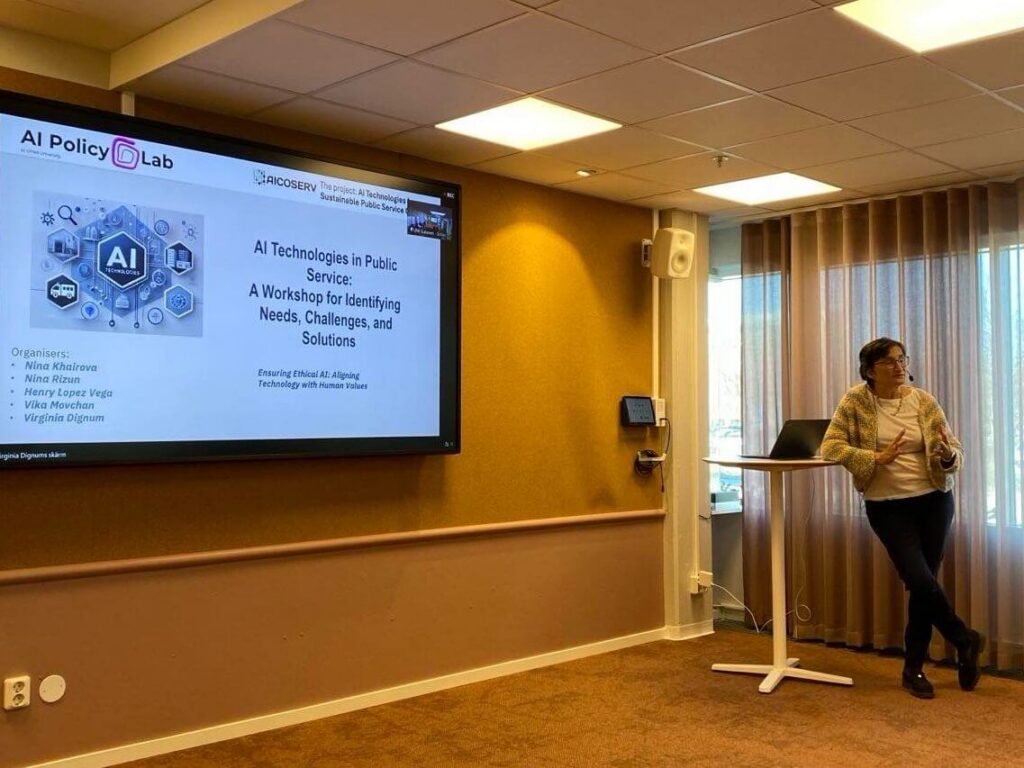
AI Technologies in Public Service: A Workshop for Identifying Needs, Challenges, and Solutions


Date & Location: April 9, 2025, Umeå University, Västerbotten, Sweden

The workshop was organised by the AI Policy Lab in collaboration with the AI Technologies for Sustainable Public Service Co-creation (AICOSERV) project members.

Overview

The workshop brought together more than 50 stakeholders from the public and private sectors, as well as academia, to explore the relationship between barriers to AI adoption in public services and the skills and expertise required to overcome them.

A central theme of the workshop was the “question zero”, the fundamental inquiry of whether AI should be used at all in a given context. As AI technologies continue to advance and expand into complex public sector tasks, the assumption that AI is always the right or necessary solution must be critically examined. The workshop challenged participants to consider not only how AI can be implemented, but to question whether it should be, emphasizing that responsible adoption begins with questioning the appropriateness and desirability of AI in specific domains.

This foundational concern set the tone for broader discussions about trust, governance, transparency, and the skillsets required to navigate the opportunities and risks of AI in public service.

Keynote Address

Professor Virginia Dignum, Director of the AI Policy Lab, opened the workshop with a keynote titled “Governing AI: Why, What, How?”

She addressed the societal and governance implications of AI, focusing on the need to critically evaluate when and how AI should be integrated into public service contexts. Her talk stressed the importance of not overlooking ethical, legal, and operational challenges in the rush to adopt AI.

Regional Case Study: AI in Västerbotten

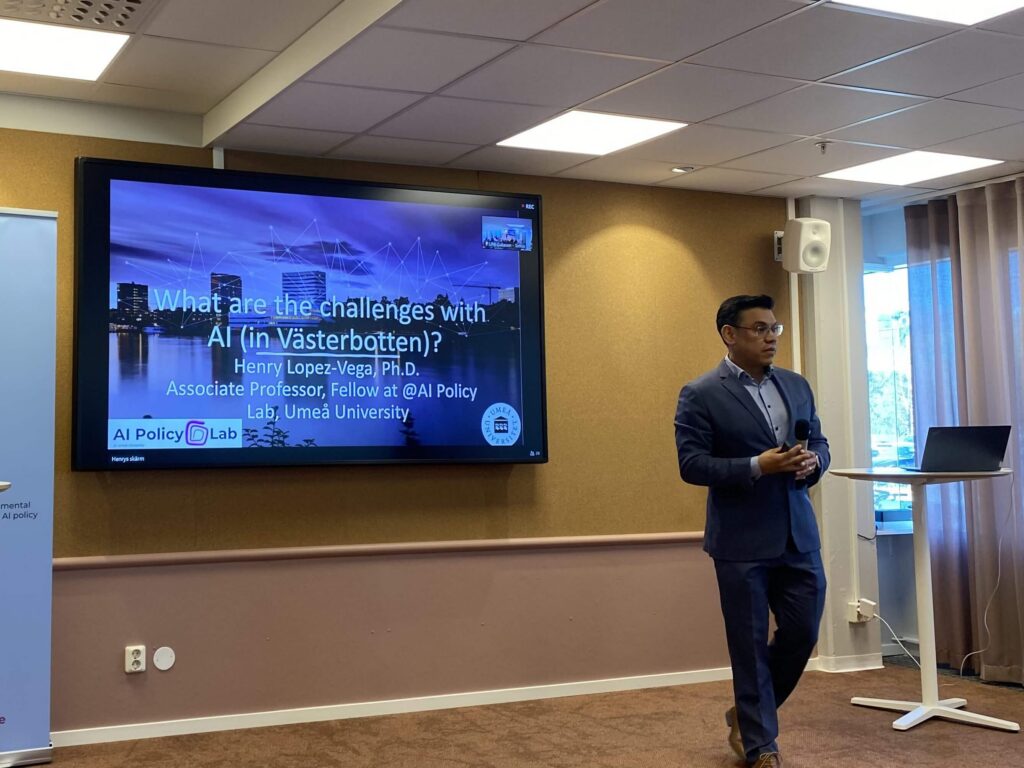
Considering the wide range of public services open to AI adoption, a recurring set of challenges consistently emerges. Whether deploying AI-driven diagnostic tools in healthcare or implementing predictive analytics within smart city infrastructures, public and private sector actors, and community stakeholders face diverse barriers. Henry Lopez-Vega, fellow at the AI Policy Lab, presented on the challenges of AI adoption in the Västerbotten region in his session titled “What are the challenges with AI (in Västerbotten)?”

His research identified three core barriers to building a responsible AI ecosystem:

  • Technological infrastructure and processes within organisations
  • Organisational culture and resistance to change
  • Lack of clarity around AI governance and ownership

Group Discussions: Skills and Stakeholder Engagement

In the second half of the workshop, participants engaged in group discussions focusing on organisational challenges, key stakeholders, and barriers to implementation. Each group then mapped the skills and knowledge needed for responsible AI adoption in their contexts.

For example, in the case of AI-supported recruitment processes, participants identified several critical barriers:

  • Lack of transparency in AI decision-making
  • Biases in training data
  • Limited legal and ethical guidelines for automated hiring

To address these issues, participants emphasized the need for professionals with a blend of competences, including:

  • Knowledge of data protection and anti-discrimination legislation
  • Skills in evaluating and auditing AI systems
  • Awareness of ethical considerations in algorithmic decision-making

Findings and Framework

The increasing efforts to implement AI across various public sector domains have led to a critical question: what types of professionals, equipped with what specific skills and competences, should lead the integration of responsible AI? Defining the essential set of skills, knowledge, and professional competences required for the effective and ethical deployment of AI in both public and private sector services becomes a key priority.

A key outcome of the workshop was the identification of a recurring set of challenges affecting. These include:

  • Low levels of trust
  • Lack of transparency
  • Unclear ownership and responsibility
  • Insufficient stakeholder awareness
  • Limited AI literacy and governance skills

To address these challenges, we propose the conceptual framework depicted in Figure 1. This framework highlights the urgent need to cultivate professionals who combine technical expertise, ethical sensitivity, and domain-specific knowledge to lead responsible AI integration. It maps the interconnected layers that influence the deployment and responsible use of AI technologies in public services, including:

  • Contextual Challenges – such as low trust, resistance to change, and limited organisational readiness
  • Structural Barriers – including unclear project ownership, inadequate governance frameworks, and insufficient infrastructure
  • Skill and Knowledge Gaps – highlighting the lack of AI literacy, ethical awareness, and domain-specific competences
  • Stakeholder Roles – outlining the importance of identifying and engaging relevant actors (e.g. policymakers, IT professionals, legal advisors, and citizens) throughout the AI lifecycle

This framework is intended to guide structured reflection and planning around AI deployment, helping ensure that technologies are not only functional but also trustworthy, inclusive, and aligned with public values. As such, it can serve as a practical tool for organisations seeking to integrate AI technologies responsibly. It encourages a systemic perspective, one that moves beyond technical feasibility to consider broader organisational, social, and ethical dimensions.

By applying this framework, decision-makers and project leads can:

  • Identify context-specific challenges before adopting AI
  • Map key stakeholders and clarify roles and responsibilities
  • Recognise skill and competence gaps that must be addressed
  • Design AI initiatives that align with principles of transparency, accountability, and fairness

Figure 1. The framework summarising the workshop’s thematic discussions

In conclusion, the workshop underscored that a stakeholder-oriented, challenge-driven approach is key to enabling responsible AI adoption. By starting with specific domain needs and mapping corresponding skills and knowledge, organisations can more effectively navigate the complex landscape of AI integration.

Responsible AI Retreat at Lövånger 

On March 17-20, 2025 at Lövånger, AI Policy Lab (AIPL), Responsible AI group and Research Group for Socially Aware AI had a 3.5-day retreat with 15 participants from both units and Francien Dechesne from Leiden University, Netherlands.

Participants discussed responsible AI from multiple perspectives – technological, ethical, and social. Below we share the key messages from the retreat. We hope to inspire future multidisciplinary discussions, workshops and projects related to responsible AI research, literacy, and practical solutions for diverse stakeholders in Sweden and internationally.

Question Zero & Human Responsibility

When we hear about new AI ventures, we need to ask the question zero: “Is the adoption of an AI tool the best solution for our current problem?” with assessments including the environmental costs of running this AI system and understanding of what specific aspects of operations it improves. This includes critically assessing who is participating, what is the provenance and the management of data, what are the bases for modelling and design choices, how will results and impact be evaluated. AI does not happen to us, we [humans] design and/or adopt and use the AI systems. 

  • Responsible AI development should follow a compositional approach, where verified datasets and models with clear principles can be combined to create new systems. This framework emphasises the need to balance ethical considerations and accuracy while accounting for differences across sectors, industries, and global value systems. The approach prioritises sustainability, transparency, control, regulation, participation, inclusiveness, trust, and fairness, with a focus on measuring societal implications and ensuring equal representation and identification. 
  • True AI fairness goes beyond mathematical equality, considering historical disparities and contextual factors, and diverse definitions of fairness, as mathematical fairness alone can still create discriminatory outcomes in complex social settings. 
  • Participation, where people meaningfully contribute to (design) decisions, strengthens democracy and supports responsible design, development, and use of AI. However, participation alone does not guarantee better outcomes; thoughtful design is needed to prevent manipulation and address blind spots by incorporating diverse perspectives. 
  • Technological change is ecological, not additive, in that it is transformative and systemic rather than simply incremental, fundamentally reshaping existing environments and society. Drawing from Neil Postman’s (1995) framework, technological innovations fundamentally transform existing systems rather than simply adding new capabilities, creating trade-offs, winners and losers, and often leading to reframing how we perceive the world. 
  • Structural challenges. Several “traps” hinder responsible AI research: the framing trap (failure to model entire systems), portability trap (ignoring context sensitivity), formalism trap (oversimplifying social concepts), ripple effect trap (missing ecological impacts), and solutionism trap (overreliance on technological fixes). 
  • AI Art. The concept of “AI as a mirror” raises important questions about artistic expression, with significant differences between the inner experience of human artistic creation versus AI-assisted art generation, challenging traditional perspectives on IP rights, creativity (human only, genAI only, human-AI hybrid), intention, and artistic value. 

If the ideas above resonate with you, we encourage to check out the AI Policy Lab LinkedIn page for common cooperation opportunities. 

Bridging the Gap Between AI Research and Policy

The future of Artificial Intelligence (AI) lies not just in its technical advancements but in its responsible governance, underpinned by human-centered principles and policies. As such, AI policy research is an urgently needed area of focus, not just AI research, not just policy research, but a deliberate intersection of the two. This realization was at the core of the recent AI Policy Summit, a collaborative platform bringing together researchers from around the world and co-organised by MILA and the AI Policy Lab that I have the previlege to direct.  This was not just an event but a pivotal step toward shaping the trajectory of AI policy and governance. As AI technologies increasingly permeate every aspect of society, their potential to drive progress must be balanced with safeguards to ensure they align with human-centered values. This balance cannot be achieved by technical or legislative approaches alone; it demands the collaborative efforts of researchers, policymakers, and civil society.

The AI Policy Summit provided a unique platform for representatives from independent research organizations, spanning academia and civil society from diverse national contexts to engage in an open, informal environment that enable deep and heated exchange of ideas. A panel discussion with policymakers from multiple countries added depth and diversity to the discussions. Their contributions underscored the varying challenges and opportunities faced across different governance frameworks. Policymakers from Sweden, Tanzania, Canada, the Netherlands, and Portugal shared insights into their regional experiences with AI regulation, highlighting both shared objectives—such as transparency and accountability—and the unique cultural and legislative nuances that influence AI governance.

I was also especially encouraged by Marietje Schaake’s keynote, which highlighted the critical role of researchers in engaging with policymakers through building lasting relationships, providing actionable insights like policy briefs, and actively contributing to both the creation and implementation of legislation, all while acknowledging the challenges both sides face.

During the two days, exchanges between the participants emphasized the critical need for localized approaches to AI policy that are informed by global best practices. The summit fostered an environment where academic and civil society researchers could present evidence-based findings while gaining a firsthand understanding of the practical realities policymakers face. This interaction not only enriched the dialogue but also set the foundation for future collaborations aimed at shaping inclusive, effective, and context-sensitive AI policies.

Why AI Policy Research Matters

The development and governance of Artificial Intelligence (AI) are complex, interconnected challenges that demand a dedicated focus on AI policy research, a field distinct yet integrative of AI technology research and policy governance. This emerging discipline addresses gaps that neither AI research nor policy alone can resolve, ensuring that governance frameworks are not only informed by cutting-edge science but also aligned with societal needs and values. While AI research focuses on advancing technology and policy research on governance frameworks, neither can address the multifaceted impacts of AI in isolation:  

  1. AI advancements without Governance: Left unchecked, rapid AI innovation can deepen societal inequalities, exacerbate environmental damage, and consolidate power among a few, undermining public trust and equitable access?.
  2. Policy without AI research: Policies uninformed by empirical evidence or understanding of AI’s dynamic landscape risk becoming outdated, excessively restrictive, or misaligned with technological realities, stifling innovation and public benefits.

AI policy research as foundation for Responsible AI

Responsible AI begins well before algorithms are written or systems deployed: it starts with the fundamental questions: What problems are we solving? For whom? And with what consequences? What are the most suitable solutions? Is it AI? Addressing these questions requires a nuanced interplay between policy and research. The summit highlighted the growing need for this alignment to ensure that AI technologies foster societal progress, uphold human rights, and contribute to global sustainability goals.

At its heart, AI policy research navigates complex trade-offs. Fostering innovation while mitigating societal inequities requires a framework that ensures AI benefits are equitably distributed, particularly to those most vulnerable to its disruptions. AI policy research creates a vital bridge between these domains by focusing on actionable, evidence-based governance. It emphasizes transparency, accountability, and sustainability while ensuring equitable outcomes. By addressing issues such as inclusivity, environmental trade-offs, and regulatory foresight, AI policy research supports:

  • Proactive governance: Anticipating the implications of AI advancements demands foresight-driven policies that anticipate potential risks and societal impacts before they arise. By proactively identifying challenges—such as biases, security vulnerabilities, or unintended social consequences—governance frameworks can mitigate harm and establish safeguards that evolve alongside technological innovation.
  • Cross-sector collaboration: Effective AI policy requires a united effort from academia, industry, and government. Collaborative frameworks enable the sharing of expertise, aligning research insights with regulatory needs and industrial priorities. This synergy fosters the creation of policies that are both practical and evidence-based, ensuring comprehensive oversight and adaptability.
  • Responsible innovation: Encouraging the use of AI only when its benefits outweigh costs and align with ethical standards?. That is, AI should be deployed only when its advantages clearly outweigh associated costs and risks. Responsible innovation emphasizes ethical design, sustainability, and equitable access, ensuring that AI systems contribute to societal well-being without exacerbating inequalities or environmental harm.

The AI Policy Summit’s Contribution

The recent AI Policy Summit brought together global policymakers, academic researchers, and civil society actors to highlight this integrative approach. Discussions focused on immediate and long-term goals, such as fostering global accountability standards, developing foresight mechanisms, and crafting practical tools for inclusive governance. By emphasizing a shared roadmap and cross-sectorial expertise, the summit illuminated how AI policy research can drive actionable solutions for the responsible development of AI technologies?. This collective effort underscores the urgency of AI policy research as a means to guide innovation and governance toward equitable, sustainable outcomes. It is a field poised not only to mitigate the risks of AI but to maximize its potential as a force for societal good. Building on insights from the summit, several ideas were proposed to solidify the role of AI policy research, including:

  • Establish Visiting AI Policy Fellowships: These programs at different research institutes connect researchers with policymakers, fostering mutual understanding and collaboration?.
  • Launch an AI Policy Research Network: A global platform to share best practices, insights, and resources for evidence-based policymaking.
  • Develop AI Policy Briefs: Translating research findings into actionable insights tailored for policymakers is essential for informed decision-making.
  • Focus on Education and Capacity Building: Initiatives like student exchanges and Erasmus programs can cultivate a new generation of leaders at the intersection of AI and governance?).

A Shared Responsibility

AI policy research is not just a necessity, it is an opportunity to ensure that AI serves humanity rather than shaping societies in ways that exacerbate inequities or environmental harm. By combining the rigor of scientific inquiry with the pragmatism of governance, this field provides a pathway to align AI innovation with ethical, human-centered values.

The AI Policy Summit marked the beginning of a critical journey, one that bridges the gap between technological innovation and governance to ensure AI serves humanity responsibly. This initiative is more than a conference or a network; it is a call to action for researchers, policymakers, and civil society to collaborate in shaping an equitable and sustainable AI future.

Looking ahead, the true measure of its success will be our ability to foster lasting impact. This includes creating actionable frameworks, building trust through transparency and accountability, and policy instruments that ensure that the benefits of AI are accessible to all. As AI continues to evolve, our collective efforts must remain grounded in shared principles of fairness, sustainability, and human-centered development.

The challenges are immense, but so too is our collective potential. By uniting diverse perspectives and expertise, we can navigate the complexities of AI with integrity and purpose. Together, we have the opportunity not only to mitigate risks but to redefine AI as a tool for societal good—one that reflects the values and aspirations of all. The journey is just beginning, but the urgency is clear. I welcome you all to join us to #InformAIpolicy, a joint commitment to building a future where AI contributes to societal progress, respects the planet, and ensures equity for all.