Project start date: 15 January 2026
Summary
The purpose of the project is to increase the rate of Deceased Solid Organ Donations in Sweden. We seek to answer critical questions to pave the way to new, thoughtful, policy for organ donation in public healthcare systems.
Background
To support policy makers understand possible effects of policies, we aim to create an Agent-Based model that emulates the behaviour of a synthetic population given a set of policies (e.g. modification of inclusion criteria for donors, increasing availability of specialised staff, adaptation of policy with proven effects from other contexts, etc.).
We use Agent-Based Social Simulations to understand systemic, individual and social reactions to critical healthcare policy changes. This is a tool for decision makers to explore different scenarios and their effects. It is not a model to generate predictions.
Prototype
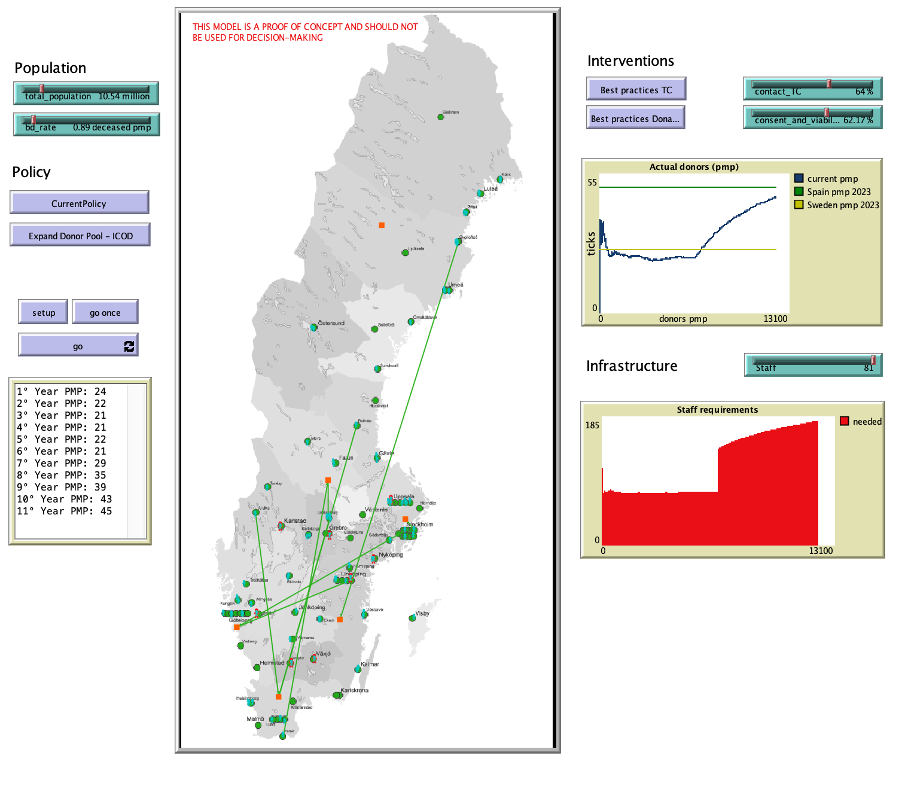
We have developed a NetLogo microsimulation as a prototype to define the granularity and scope of the model. Further research is needed to develop a robust, representative and useful model. We use publicly accessible, anonymous data for calibration.
Agents
In the prototype, there are three main types of human agents: Donors, Staff and Transplant Coordinators. All have partially defined behaviour; a main goal of the research we are pursuing is to expand their agency by understanding the target system’s stakeholders, their needs, beliefs, desires and intentions.
![Simplified diagram of transition states for Donor agents [1].](https://aipolicylab.se/wp-content/uploads/2026/03/image-3.png)
Places
Intensive Care Units are, by law, the only places where donations can occur. The work of Staff and Transplant Coordinators is to make sure the donated organs reach the intended donors in time. The time constraints depend on the organ type and its cold ischemia time.
Expanding the model with geographical information is a potential avenue that we are considering.?
Policies
Policies describe interventions that can be taken by decision makers. We tested the implementation of policies that proved successful in Spain in the prototype model. Policies can be combined in many ways; this provides an experimentation environment for decision makers. Having a long horizon is required, as public health change happens slowly, and we must consider the impact on public opinion, staff workload, and infrastructure capabilities.
![Visual ODD diagram for prototype [1].](https://aipolicylab.se/wp-content/uploads/2026/03/image-2.png)
Further Details
[1] Fabris, B., Tucker, J., & Lorig, F. (2025). Using Agent-Based Social Simulations to Inform Organ Donation Policymaking?: Adopting the Spanish Approach in Sweden. The 26th International Workshop on Multi-Agent-Based Simulation?: Accepted Papers. Presented at the The 26th International Workshop on Multi-Agent-Based Simulation (MABS2025) Detroit, Michigan, USA, May 19th-23rd, 2025. Retrieved from https://urn.kb.se/resolve?urn=urn:nbn:se:mau:diva-75295