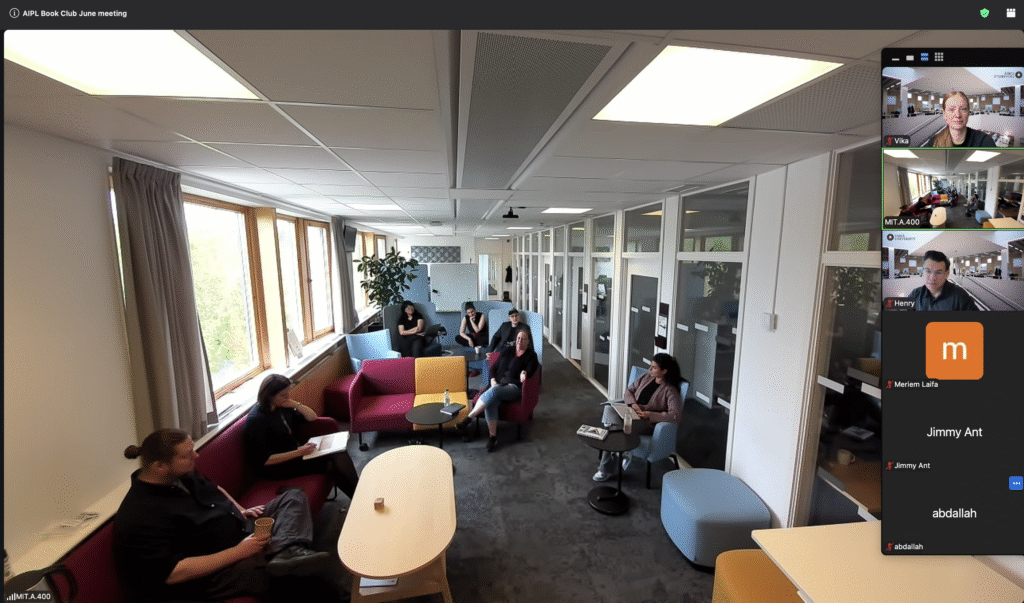
Book Club discussion on “The AI Paradox: How to Make Sense of a Complex Future”
On Friday at AI Policy Lab @Umeå University we had a book club discussion on “The AI Paradox: How to Make Sense of a Complex Future” by Professor Virginia Dignum.
We explored the book’s eight AI paradoxes and reflected on what they mean for education, governance and society.
🧠 One discussion focused on the Intelligence Paradox: The more AI can do, the more it highlights the irreplaceable nature of human intelligence. Rather than asking whether AI is intelligent, we considered a Competence Paradox. What is a system actually capable of? How robust, trustworthy and reliable is it?
🎓 Education sparked one of the longest discussions.
Generative AI creates a new educational grey zone. It can support learning and reduce unnecessary workload. It can also create an illusion of competence, shallow learning and what one participant called metacognitive laziness.
A key idea was productive friction. Learning should not be effortless. The challenge is not to remove struggle, but to ensure that struggle leads to understanding.
This raises a difficult question: should education move away from assessing products and focus more on assessing processes, reasoning and reflection?
👩🎓 Another important point was that students should be part of the solution. They often understand how these tools are used in practice better than institutions assume.
⚖️ The Solution Paradox: Solving problems with technology often creates more problems, lead to an interesting conversation. New tools alone do not transform education. Smartboards did not. Computers did not. AI will not either.
Technology without training, support, strategy and institutional change risks becoming an expensive distraction.
🏗️ We also touched upon the material side of AI. Discussions about responsible AI often focus on models andc ompaniex, and pay less attention to energy use, exploitation of labour and governance.
Responsible AI cannot be only about models and companies. It must also address the systems, power structures and resources that make AI possible.
⏳ Another theme was speed. In AI, faster is often assumed to be better. But is it?
AI forces urgent decisions, yet responsible decisions often require time. Perhaps moving more slowly can sometimes lead to better and more democratic outcomes.
🌍 Some of the takeaways were:
– AI is not something that is happening to us. It is something we are actively building, shaping and governing.
– That means responsibility sits with researchers, educators, institutions, companies and policymakers alike.
– Who gets access to powerful AI systems? Who benefits? Who bears the costs? And who takes responsibility for shaping the future of technology and society?
🙏 Thank you to everyone who joined the discussion and shared their perspectives. Interdisciplinary conversations like these remind us that the future of AI is not only a technical challenge. It is a human one.