AI Policy Lab Externship Information Session with Viktoria Movchan and Tatjana Titareva
Date: September 24, 2025
?? Presentation Slides can be downloaded here.

AI Policy Lab Externship Information Session with Viktoria Movchan and Tatjana Titareva
Date: September 24, 2025
?? Presentation Slides can be downloaded here.
Date & Location: August 27, 2025, Umeå University, Västerbotten, Sweden
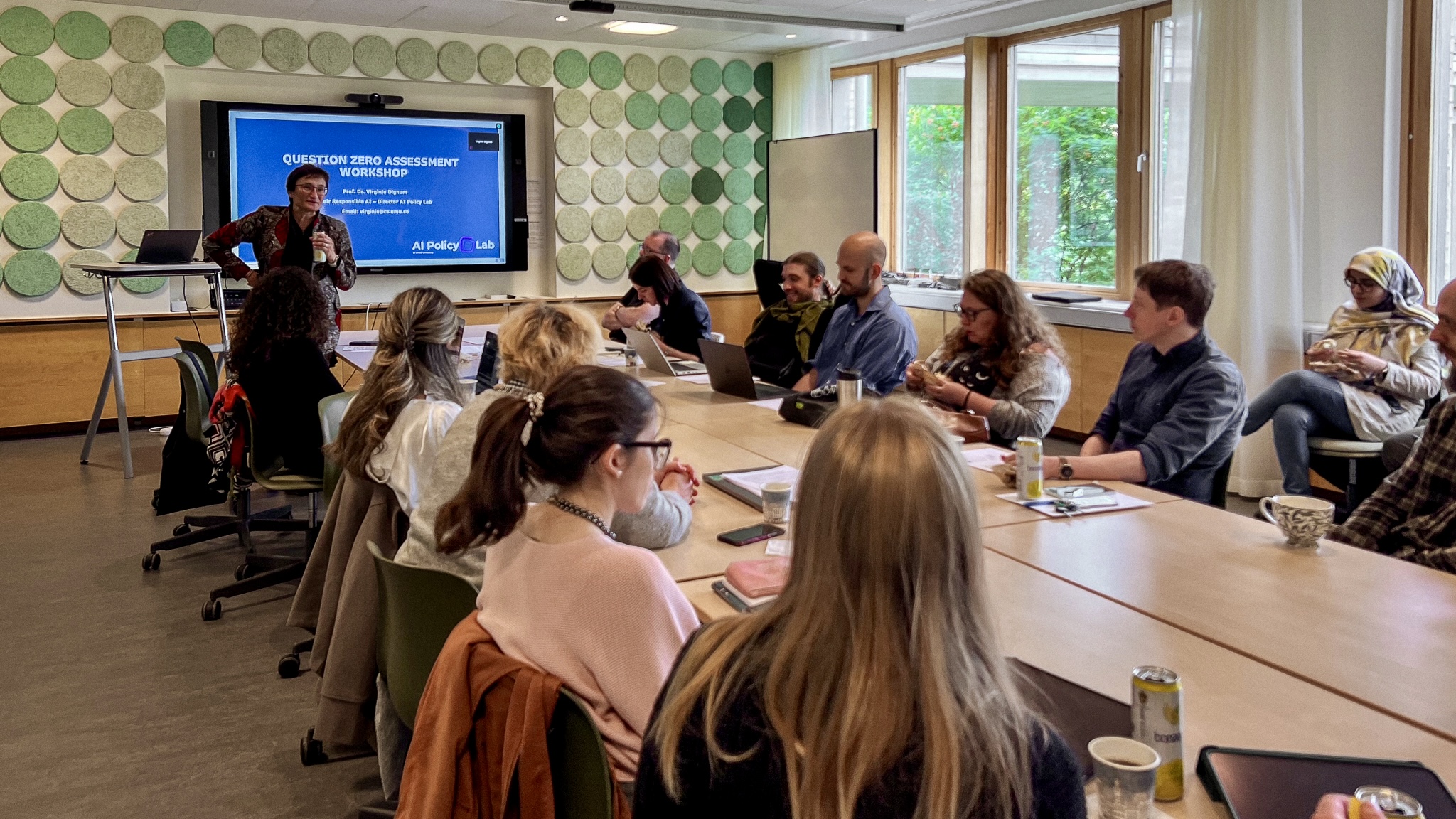
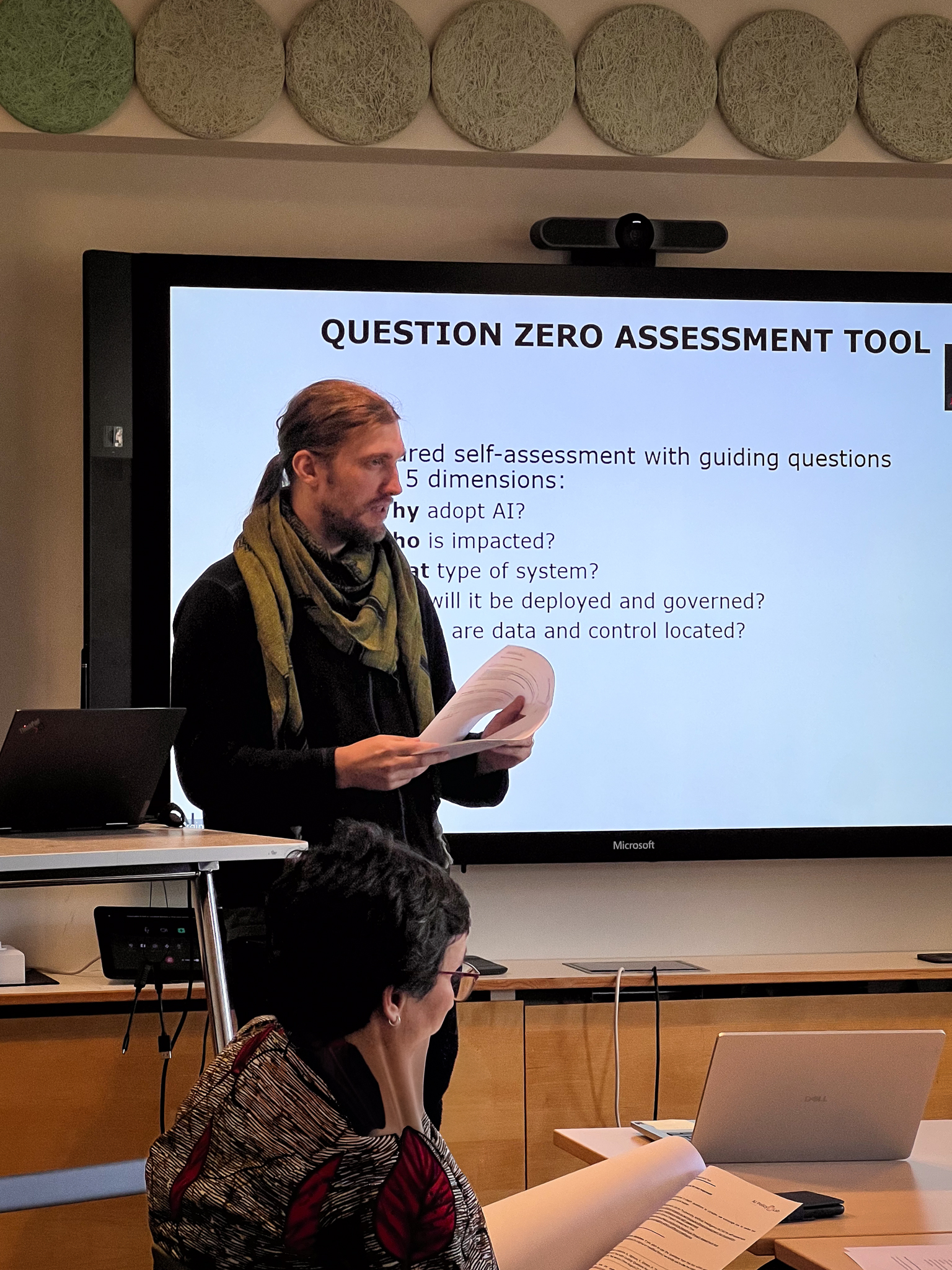
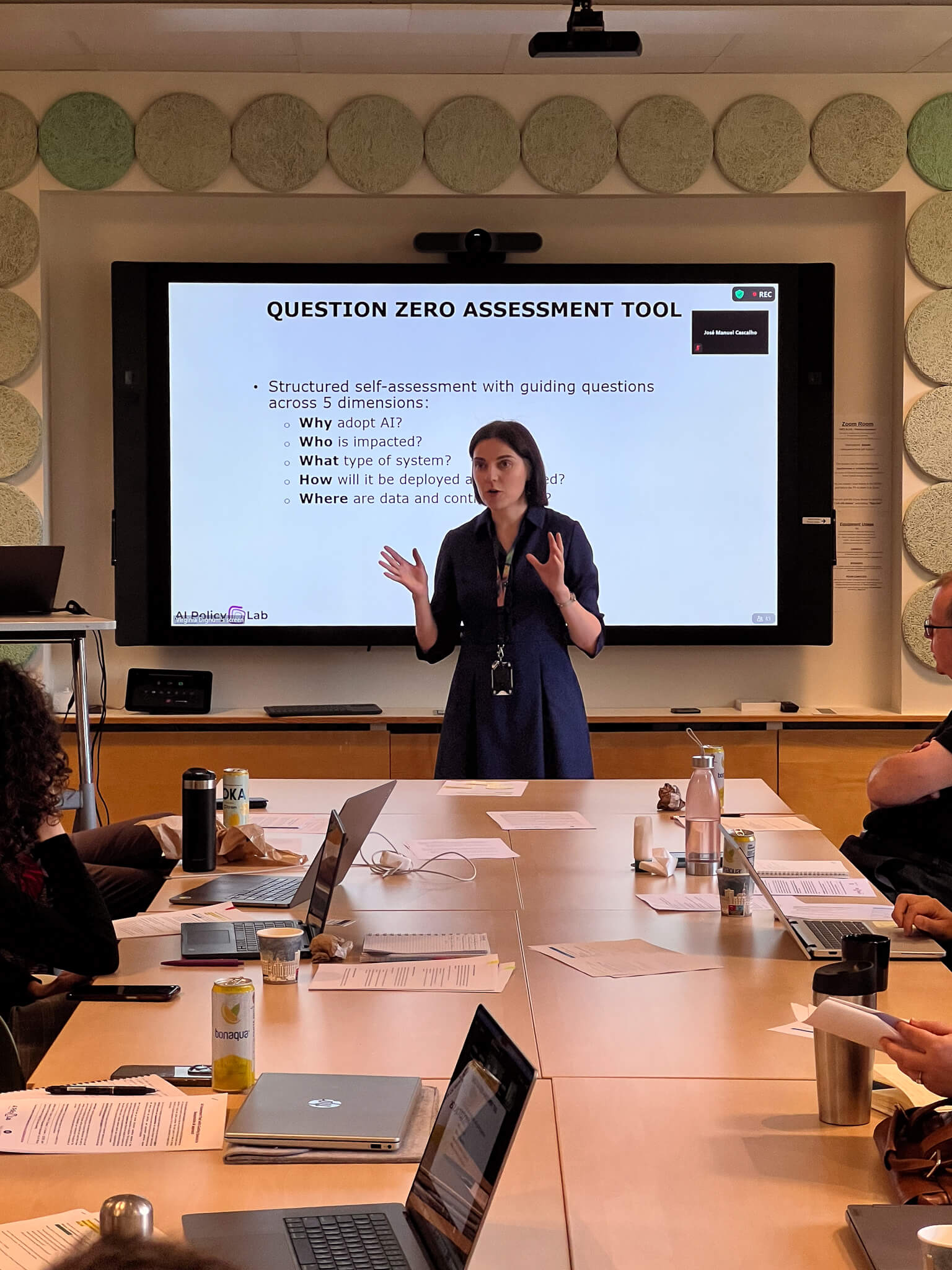
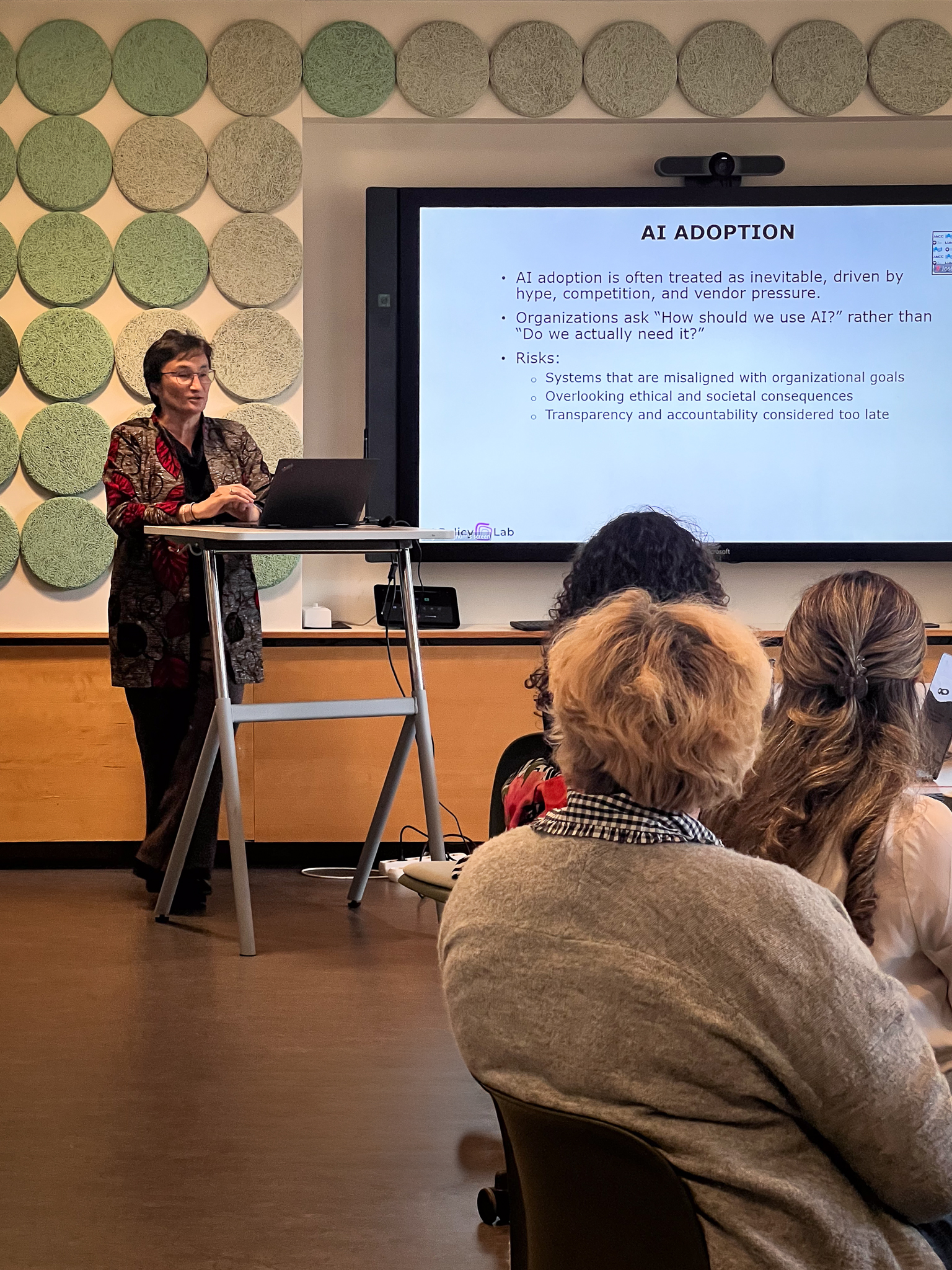
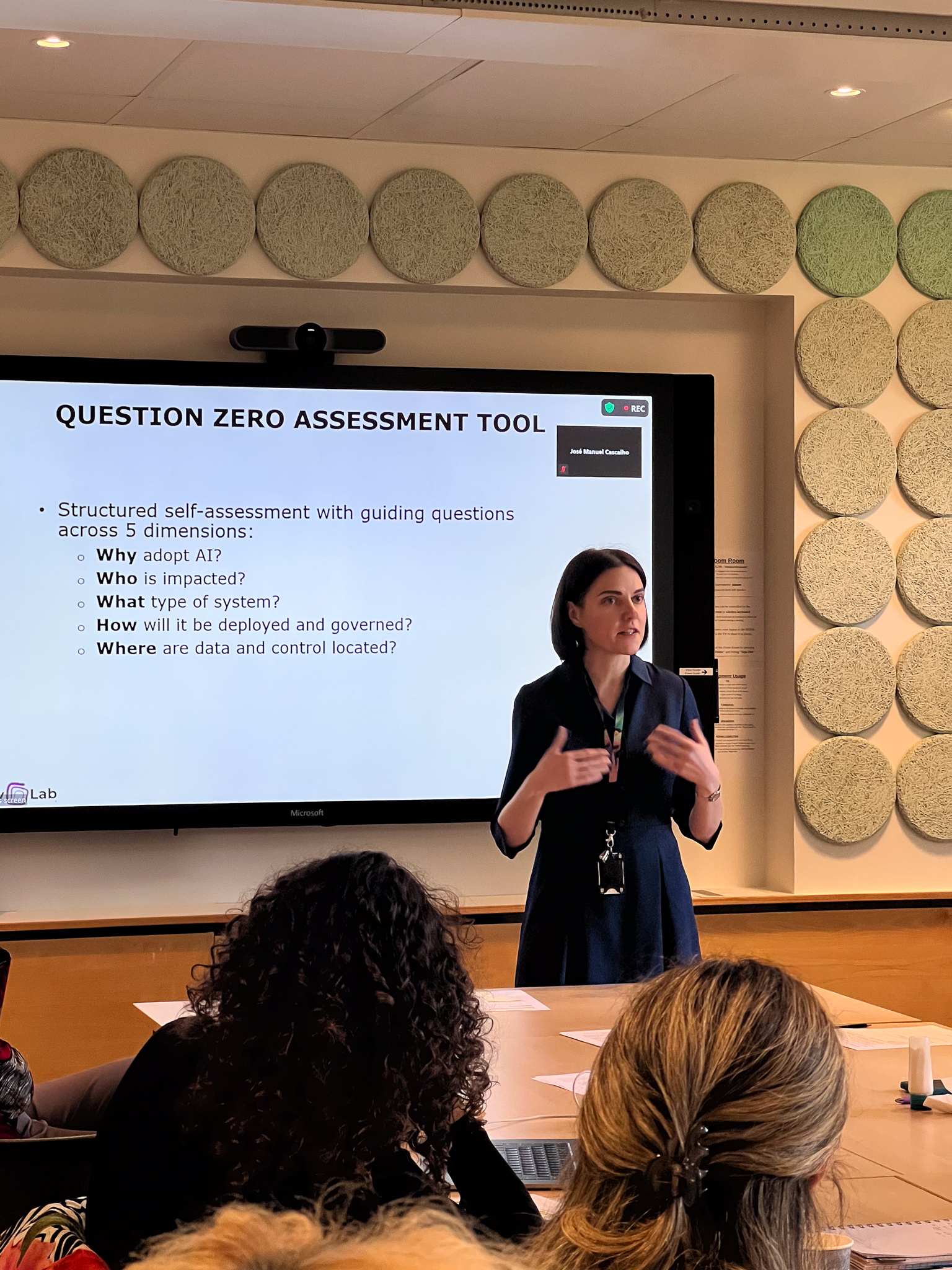
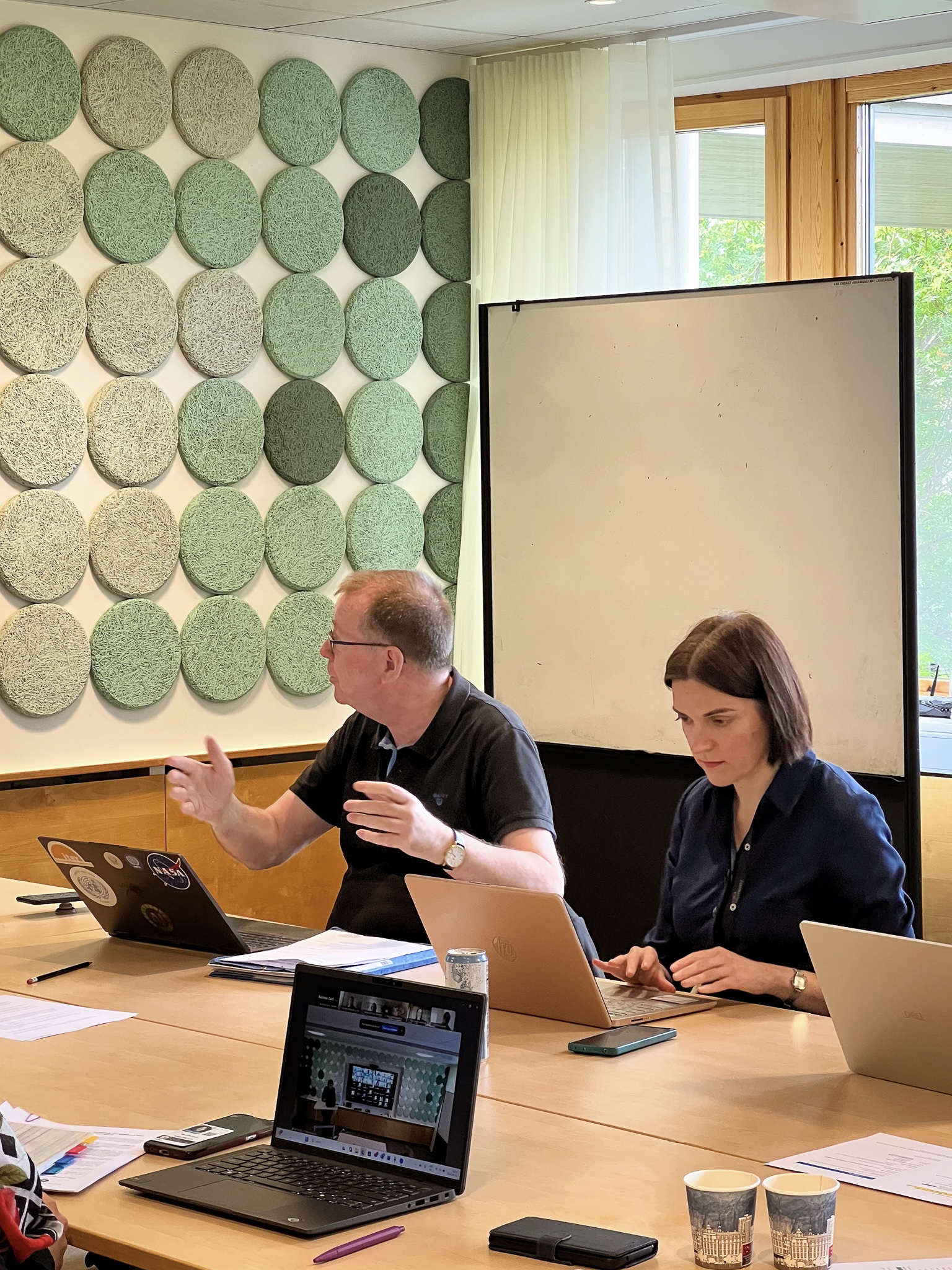
On 27 August 2025, more than 100 participants joined the AI Policy Lab workshop Responsible AI Self-Assessment: Start with Question Zero at Umeå University and online. Together, we tested and debated the Responsible AI Self-Assessment Tool, designed to help organisations pause, reflect, and ask why before moving into AI adoption.
You can explore the current version of the tool here:
Responsible AI Self-Assessment Tool (PDF)
The workshop brought together voices from academia, industry and the public sector, sparking vibrant conversations around responsible AI. Participants reflected on questions such as:
We are deeply grateful to everyone who joined, shared perspectives and challenged assumptions. Your input is vital to shaping a practical, responsible approach to AI adoption.
The tool is still a work in progress. Feedback from this workshop will be implemented directly into the next version of the tool. Future workshops will continue to stress-test and evolve it, ensuring it meets the needs of diverse organisations working with AI.
As Virginia Dignum, Director of the AI Policy Lab, put it:
“Responsible AI isn’t AI-first, it’s people-first. It starts by asking why, not rushing to deploy.”
Interested in taking part in upcoming sessions? Keep an eye on our website and LinkedIn page for updates.
Irum Younis Khan (Dept. of Management Sciences, COMSATS University Islamabad (CUI))


Published on 11 August 2025
1. The Material Demands of AI
Artificial intelligence has been presented to the world as a technology driving economic and social transformation, being efficient and minimal environmental impact. Yet the reality of high energy and natural resource consumption, to keep its data centers operational, often remains invisible in mainstream narrative. This continuous energy and freshwater demand positions AI as a material actor within the planet’s ecosystem with considerable ecological costs, marking a major shift in Anthropocene, where human technologies shape planetary systems (Creutzig, et al., 2022; Wu, et al., 2022). Although the CO2 emissions from data centers have gained much attention, the water consumption remains opaque due to significant lack of independent third-party auditing and assessments (US Department of Energy, 2024). The only information source available comes from the tech giants owning these data centers. With accelerated adoptability rate of AI, expansion and scaling of Hyperscale and Edge data centers requires massive quantities of fresh, potable water – both directly and indirectly – draining the local sources, that local communities rely on, for their livelihoods. Data centers, though used for diverse digital services, are increasingly being scaled to host AI workloads. The lack of transparency and clear policies in design choices, selecting geographical locations and inequities in stakeholder inclusion emerges as a critical issue.
The increased deployment of AI-based systems results in increased demand of its infrastructure, raising urgent concerns about planetary boundaries. Water, a core utility, is a finite and unevenly distributed natural resource and already under stress in many regions (UNESCO, 2021). AI, with its environmental cost, cannot be treated an immaterial. Overlooking AI’s water consumption in sustainability assessments is no longer an option. There is a pressing need of transparency in sourcing, usage and reporting frameworks across the AI value chain.
Data centers rely heavily on fresh water with each query costing a measurable amount of water, as mentioned recently by Sam Altman, CEO of Open AI. Fresh water is used directly for ‘cooling’ and maintaining optimal operational costs (McKinsey & Company, 2024). A single hyperscale datacenter, for example, can use up to 550,000 gallons of water per day, totaling to 200 million gallons (760 million liters) annually. This is enough quantity for approx. 8,000 households (5 person) for their basic needs, based on WHO’s per capita daily water requirement (WHO, 2020).
The situation gets further complicated due to water-energy nexus. The demands of vast AI computational resources need electricity. Globally, most of electricity is produced via thermal or nuclear power plants which places additional strain on freshwater reserves. Analyzing the nexus reveals that the indirect water consumption, needed for electricity generation, can match or even exceed the amount of water needed for cooling, compounding the overall water footprint of AI. Despite this scale, companies do not share the Water Usage Effectiveness (WUE) report consistently and transparently (IEA, 2024). The claims of replenishment of water consumption such as ‘water-positive’ pledges remain vague, often lacking critical information about when, where and how freshwater is drawn and what is actual ecological benefit gained (Microsoft, 2025). Such data is vital in understanding the offset occurring outside the watershed, where extraction happens and therefore fail to provide meaningful accountability.
2. Water-Stressed Geographies and Data Center Boom
The freshwater scarcity has affected billions of people in recent years. Yet the growing mismatch between data center geographical placement and water availability reflects a negligence towards this escalating crisis. A closer look at spatial convergence of water risk locations and number of data centers they are hosting, reveals the overlooked construction of digital futures on fragile water foundations (World Resources Institute, 2023; Data Center Map, 2024). Countries like Belgium, Spain, Chile and India are hosting large number of data centers despite high or extremely-high baseline (2023) and projected (2030) water stress level, as reported by Aqueduct Water Risk Atlas. India, for instance, hosts 265 datacenters while facing extreme water stress while major tech firms like Google, plan to set additional hyperscale data centers in the country. Spain hosts 161 data centers with presence of Microsoft, Google, Meta and Amazon Web Services and Belgium has 48 data centers supporting operations of significant and long-standing hyperscale data centers such as Google.
Between depletion of water resources and economic benefits, countries show a paradox between digital infrastructure growth and water scarcity. The local ecosystems and communities increasingly compete for resource availability, without any mechanism to govern or mitigate this competition (Lehuedé, 2024; Vinuesa, et al., 2020). Meanwhile the developing countries position themselves in AI revolution by actively welcoming foreign investment brought by data centers as part of their digital transformation goals. Nations like South Africa, Egypt, Angola, and Pakistan, with ongoing water scarcity challenges, seek investments in data centers by offering land and rebates. They seemingly ignore any consideration of ecological trade-off that comes along with economic prosperity. Egypt, for example, faces extremely-high projected water-stress and when combined with its rising number of AI data centers, it may have a short-term economic uplift but also deepen long-term water scarcity.
3. AI Growth and Ecological Fragility
With scaling of global AI models and increase in localization, demand for data centers will intensify. This expansions risks triggering a rebound effect (Hertwich, 2005). The efficiency gains in AI models will lead to increase in overall resource consumption and a need for more data centers. With AI capabilities getting more distributed and embedded in daily systems, the consumption of energy and water will be accelerating too. So, despite any improvements in AI model efficiency or cooling innovations, the need of accountability and transparency in its environmental impact cannot be denied. To keep up with the demand, the data center operators pursue locations with low operational cost and greater water accessibility. Such sites are often situated in resource-constrained regions. Meanwhile developing countries are ready to avail this opportunity for digital transformation and foreign investment. However, any international standard, guiding the integration of water risk in AI infrastructure policy is still missing, leaving the discussions to fragmented national strategy or at public private discretion.
The absence of regulatory safeguards, along with its environmental impacts, may intensify conflicts between data center operators, agricultural users, diverse industrial consumers and local populations who share freshwater sources. Such conflict may lead to disrupted food systems, local protests and inequitable water allocations, and in some cases, the corporate interests overriding public welfare. Such politicization may further destabilize already vulnerable communities.
The expansion of AI calls for accountability of its environmental footprint in sustainability and governance debates requiring independent audits, inclusive planning and enforceable global standards. In Anthropocene, responsible AI must align with planetary limits and social equity or otherwise risk heavy ecological strain and systematic injustice.
References
Creutzig, F., Acemoglu, D., Bai, X., Edwards, P., Hintz, M., Kaack, L., . . . Rejeski, D. (2022). Digitalization and the Anthropocene. Annual review of environment and resources, 47(1), 479-509.
Data Center Map. (2024). Search data centers by country. Retrieved from Data Center Map: https://www.datacentermap.com/
Hertwich, E. G. (2005). Consumption and the rebound effect: An industrial ecology perspective. Journal of industrial ecology, 9(1?2), 85-98.
IEA. (2024). Data Centres and Data Transmission Networks. Retrieved from International Energy Agency (IEA): https://www.iea.org/energy-system/buildings/data-centres-and-data-transmission-networks
Lehuedé, S. (2024). An elemental ethics for artificial intelligence: water as resistance within AI’s value chain. AI & SOCIETY, 1-14.
McKinsey & Company. (2024, September 17). McKinsey.com. Retrieved from How data centers and the energy sector can sate AI’s hunger for power: https://www.mckinsey.com/industries/private-capital/our-insights/how-data-centers-and-the-energy-sector-can-sate-ais-hunger-for-power
Microsoft. (2025). Microsoft.com. Retrieved from Environmental Sustainability Report 2025: https://www.microsoft.com/en-us/corporate-responsibility/sustainability/report/
US Department of Energy. (2024). Recommendations on Powering Artificial Intelligence and Data Center Infrastructure. Retrieved from US Department of Energy: https://www.energy.gov/sites/default/files/2024-08/PoweringAIandDataCenterInfrastructureRecommendationsJuly2024.pdf
Vinuesa, R., Azizpour, H., Leite, I., Balaam, M., Dignum, V., Domisch, S., . . . Fuso Nerini, F. (2020). The role of artificial intelligence in achieving the Sustainable Development Goals. Nature communications, 11(1), 233.
WHO. (2020). Domestic water quantity, service level and health (2nd Ed.). Retrieved from World Health Organization: https://iris.who.int/handle/10665/338044
World Resources Institute. (2023). World Resources Institute. Retrieved from Aqueduct Water Risk Atlas: https://www.wri.org/applications/aqueduct/water-risk-atlas
Wu, C., Raghavendra, R., Gupta, U., Acun, B., Ardalani, N., Maeng, K., . . . Gschwind, M. (2022). Sustainable ai: Environmental implications, challenges and opportunities. Proceedings of Machine Learning and Systems, 4, pp. 795-813.
Keywords (comma separated):
AI governance, water-energy nexus, Anthropocene, environmental sustainability, ecological costs of AI, data center impact
How to cite this article:
Khan Y. (2025). The Ecological and Ethical Cost of Scaling AI. AI Policy Exchange Forum (AIPEX). https://doi.org/10.63439/LGGN1494
Workshop #288: An AI Policy Research Roadmap for Evidence-Based AI Policy
Date & Location: June 26, 2025, Oslo, Norway
At the UN’s Internet Governance Forum (IGF) 2025 in Oslo, Norway, AI Policy Lab @Umeå University (Virginia Dignum, Jason Tucker, Tatjana Titareva and colleagues) and Mila – Quebec Artificial Intelligence Institute (Isadora Hellegren Létourneau, and colleagues), in cooperation with our partners including Alex Moltzau, Eltjo Poort, Neema K. Lugangira, and many others, launched the Global AI Policy Research Network (GlobAIPol). The network invites diverse stakeholders to share practical knowledge that supports ethical, transparent, and evidence-based practices for shaping inclusive and trustworthy AI policies. The session also encouraged global stakeholders to endorse the Roadmap for AI Policy Research.
– Explore GlobAIPol
– Endorse the Roadmap for AI Policy Research
Three key takeaways:
The official session summary is now available:
– Read the official session summary on the IGF website (tab “Report”)
– Watch the full session recording
Key insights from our session:
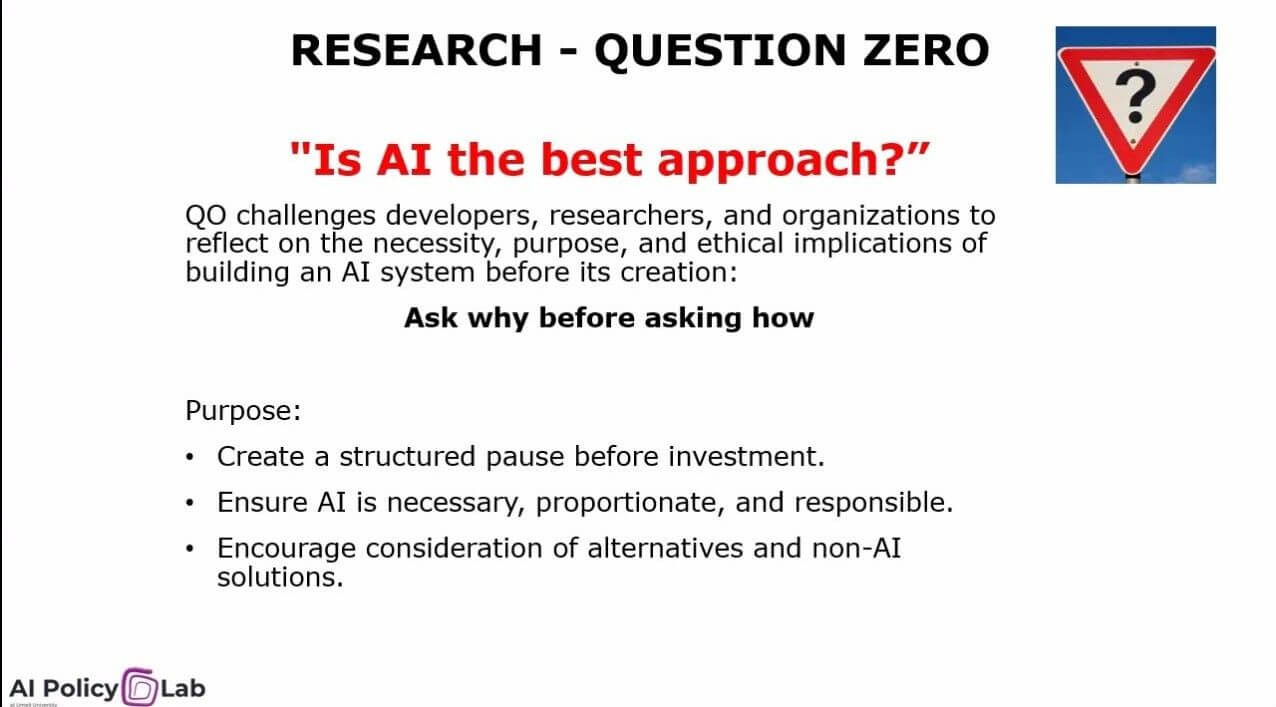
“AI does not happen to us! AI is designed by humans. We make the choices.” – Professor Virginia Dignum’s keynote reminded us that before asking how to implement AI, we must ask Question Zero: Is AI the best option here? We need to shift from fragmented, reactive policies to coordinated, evidence-based strategies rooted in ethics and justice.
The interventions and discussion revealed critical lessons from global perspectives:
The EU is demonstrating promising approaches with the European AI Office expanding from 97 to 140 staff by the end of 2025, supporting regulatory sandboxes and international collaboration including a €5 million generative AI initiative with Africa.
In healthcare, we must move beyond treating AI as a “magic pill” and build upon existing regulatory frameworks – just as we trust paracetamol today because of rigorous oversight developed several decades ago.
Well-designed regulation stimulates innovation rather than slows it down. Different countries need diverse legislative approaches harmonised with local values, not a one-size-fits-all global AI governance structure.
The time to act is now. AI is shaping our collective future, and how we act today will define who benefits, who is heard, and who is left behind.
Petter Ericson (AI Policy Lab, Department of Computing Science, Umeå University)


Published on 24 June 2025
1. Introduction
It is common for technology to be used to obscure the role of humans, and artificial intelligence (AI)is a field where this is even more true than for many others. From ghost workers and data scraping to algorithmic management and automated decision making, AI technologies are used to displace, appropriate, and hide human labour in various ways. Decisions are hidden inside technical systems, externalising them from individuals and organisations who could be held meaningfully accountable, which can make agency and power flow in new and often poorly understood ways. By having automated systems imitate humans, teleworkers can be seamlessly swapped in and out as needed with users none the wiser, making the systems appear significantly more capable than they actually are.
A useful abstraction for studying and exposing the workings of these systems is to consider how and where information is flowing through them. However, tools for such analyses tend to either be highly abstracted and focused on the broader sociotechnical systems where AI components are situated, or highly technical and focused on the details of specific software and hardware architectures, or on idealized and abstract models thereof. The proposed work will attempt to bridge this gap. On the one hand, it will take a more rigorous approach grounded in information theory to qualify and quantify the information that the humans involved share both through some specific technical system and through outside channels. On the other hand, it will take a wider view on the concrete workings of those technical systems, incorporating sociotechnical metadata into analyses of digital information flows.
In sum, we aim to use tools and methods from information theory and sociotechnical system modelling, together with formal graph models and complexity theory, to investigate and explain how diverse human labour and knowledge is discretized, datafied, and expressed throughout the development and deployment of different types and architectures of AI systems.
A complementary aim of this work is to build on and further develop existing research connecting information, computation, labour, and value, and how these concepts interact, specifically in the context of AI systems, making concrete contributions to interdisciplinary studies on AI and data work. A second major aim is to yield new insights into how to quantify and qualify information flows, through a focused study of sociotechnical systems involving AI components, where information and its flows in the digital realm can be directly studied, and comparisons can be made to both models and empirical realities of the social realm surrounding them.
Ultimately, we aim to investigate the following research questions:
* RQ1 What types of information flows can be identified within different AI system architectures, and how can these be formally categorized?
* RQ2 How do human actors contribute to and engage with information flows in and around AI systems, and how can these social interactions be systematically modeled?
* RQ3 How can we develop and validate models of information flows in AI-based sociotechnical systems that integrate both technical and human components? * RQ4 How do modeled information flows reflect or reinforce particular organizational or institutional power structures?
2. Related work
Though to the best of the authors knowledge there is very little research on precisely the present topic, its interdisciplinary nature means that there are a number of intersecting areas of active research. In particular, works that cover the intersection between AI and information theory, between information theory and labour, between labour and AI, and between any of these three areas and sociotechnical modelling are all relevant.
For the first intersection, Jeon and Roy have recently investigated the connections between Bayesian machine learning and Shannon information theory, drawing an equivalence between the cumulative errors during a learning process of an optimal machine learning algorithm, and the amount of information contained in the data. From a different angle, several works such as Tseng et al. [2] and [3] have looked specifically at large language models (LLMs), drawing on compression and entropy calculations to study the use, and training, respectively of LLMs as related to natural language texts.
For the second, Dantas [4] has drawn direct connections between information and both labor and value in an explicitly Marxist framework, distinguishing between not only use and exchange value, but also semiotic value, and deriving a specific notion of information work which will be of direct use in the proposed work. Dantas also draws a distinction between random and redundant information work, which is similar to the distinction between semantic and syntactic information work in [5] which is further nuanced into an explicit spectrum in [6].
The third intersection is itself a broad area, with many different aspects of relevance. Nguyen and Mateescu [7] gives a good overview of the current landscape in relation to Generative AI specifically, while Davis [8] provides a broader review of relevant issues, making an explicit (and useful) distinction between cases where AI use impacts labour demand (through automation) and those relating more to worker power (through surveillance, algorithmic management, and the like). Further, works such as Crawford [9], Miceli and Posada [10], Gray and Suri [11], Merchant [12], Sadowski [13], and Mejias and Couldry [14] are all relevant for further developing this work. The Data Workers Inquiry (https://data-workers.org) will be another important source of alternate perspectives on AI and labour.
In terms of studying AI sociotechnical systems, once again several active areas are of interest. In particular Wu et al. [15] has developed a framework for integrating various types of models of sociotechnical systems (STS) into a single meta-model. Several modelling languages for sociotechnical systems exist, including STS-ml [16], which was developed for cybersecurity applications, and the host of standards and notations related to Business Process Model and Notation (BPMN), such as Decision Model and Notation (DMN), which is particularly relevant for models integrating AI decision support systems. However, all of these abstractions and models tend to integrate assumptions that are not always helpful for the purposes of this work. A relevant example of how existing modelling framework scan be extended to cover new areas is [17], which adds properties and functionality to STS-ml in order to check sociotechnical systems for compliance with the EU General Data Protection Regulation (GDPR).
A relevant parallel effort, though not directly related to the work we propose here, is that of Gutierrez Lopez and Halford [18], who aim towards an extension of XAI principles that including the sociotechnical environment of the machine learning system.
3. Aims
The main contribution of this work will be to integrate previous work on sociotechnical systems modelling with several notions of information and labour, specifically in the context of artificial intelligence. An additional benefit of this work will be to lay a basis for a further analysis of agency and accountability: By studying the information flows and potential inputs and decisions from humans involved in an AI sociotechnical system, together with an analysis of the power relations among them, accountability and responsibility can be transparently and meaningfully assigned.
We hope to make meaningful contributions to the practical use of information theory and information flow, as well as yield actionable and concrete directions for further exploration of new AI sociotechnical architectures. As part of this, a major component will consist of qualitatively and quantitively analysing the information flows into and out of AI and ML systems, which will also give new and useful insights into the design of Hybrid AI systems in particular.
By creating concrete tools and methods for tracing information flows through both technical and social layers of AI systems, this work will attempt to offer not just theoretical insight, but practical value for those developing, regulating, or critically analyzing such systems. In a time when the societal consequences of AI are increasingly opaque yet consequential, this research will provide actionable models that can inform transparency standards, system audits, and future AI governance efforts.
4. Preliminary results
4.1. Categories of information
A foundational topic of this work includes clarifying and classifying different types of information. In particular, though at extreme small ranges reality can occasionally appear to be digital, for most practical purposes, it is continuous. In contrast, digital information, and computer and AI systems, while implemented on physical hardware, are conceptually and practically discrete. As such, while abstractions of the human and physical sections and relations of a sociotechnical system are going to inevitably be lossy, for the digital parts it is in principle possible to be both precise and concrete. This then, must be our first distinction between fundamentally different types of information: Abstracted notions and models of the real world, and concrete digital bits and bytes.
In terms of different theoretical notions of information, we further contrast the more mathematical definitions of Shannon [19] (’minimal code’) and Kolmogorov [20] (’minimal program’) with the Batesonian concept of ’a difference which makes a difference’ [21]. A fourth relevant concept is Corning’s’ control information’[22], which rather than connecting Shannon entropy/negentropy directly to the physical thermodynamic concepts with the same name, instead quantifies the amount of information contained in some signal or phenomenon by the amount of physical changes that it can effect. An example taken directly from Corning [22] is that of a car approaching a stoplight. If the driver does not notice or understand the traffic light, there is no control information being transferred by whatever light is shown. Only if the driver both sees the light, understands it, and is prepared to change the future trajectory of the car, is there any control information being sent out by the light switching to red. Broadly, we can thus consider two very different types of information flows: The almost entirely discrete and abstract digital information exchanges between and inside of software components, and the messy, socially situated, and necessarily contingent and abstracted information flows that can be modelled to exist between humans, technological artefacts, and their surrounding physical context. The main interest of this work lies precisely where these information flows intersect and interact.
4.2. Human-computer information interactions
With a minimal distinction of information flows as above, consider the interactions between a human and a computer system: the transfer of information from human to computer will necessarily abstract some concrete intention of the human into a concrete digital signal, but likewise a (digital) computer output will take on a specific meaning to the human which depends on their prior knowledge and the context in which the output is given. We can depict these shifts as in figure 1.
4.3. Analysis example
As an illustrative example of the type of analysis that we aim to make more concrete, detailed, and empirically grounded, consider the case of an article being written about a sports event. It is, at this point, plausible that such an article could be written by a large language model (LLM) given an appropriate prompt, including some sort of summary of the ’relevant facts’ of the event in question (e.g. the final tally of points, who made them when, and any injuries and other specific incidents, which are accessible from some sort of API). The situation would look something like figure 2. We can complicate this picture, however, by adding more context. The article will not reach publication without an editor, and the hidden labour that has resulted in the LLM is entirely absent in our initial figure, as is the work to set up the “sports API” and the later work to feed it with the ’relevant facts’ from observations of the event. A more realistic picture emerges, as in figure 3.
Compare this to a situation where a human writer is the author of the same article. Though the plain (abstract) facts of the event in question may be the same, the human will also have access to an infinitely larger context as part of their writing process, both through direct experience and memory, and through communications with other humans, computer systems, and physical objects such as books and recordings, nevermind the sights, sounds, and smells of the event itself if the writer was also present at the event. In this case, the situation will look more like figure 4. This too can be made more complex, particularly if we imagine the writer to make use of an LLM for writing assistance of some sort, yielding a situation as in figure 5.
5. The path forward
Though primarily based in computing science, the nature of the problems addressed by the work call for an interdisciplinary approach. Notably, by building on existing work in Science and Technology Studies, as well critical marxist literature, it is possible to better situate and analyse the information flows and AI sociotechnical systems inside existing societal power structures and socioeconomic realities. In addition to the various theories of information mentioned in Section 4.1, we will also distinguish between different types of information work, as outlined in Section 2. The distinctions between data, information, and knowledge have been explored e.g. in [23], [24], and these perspectives will also be considered.
We will primarily be building on existing frameworks for the analysis of program structure and information flow through software. Notably, the theory and practice of Quantitative Information Flow (QIF) analysis in computer security, though focused on detecting and plugging information leaks between public and private variables under static source code analysis conditions, offers a range of useful tools for modelling intentional information flows as well. From a software engineering lens, constructing program flow graphs and clearly and consistently delineating components in a software system is a well established practice, with a host of frameworks available for use. An example of an abstract framework for describing program and information flows that has been specifically developed for purposes of describing Hybrid AI systems is the boxology of Harmelen and Teije [25].
For situating a software system in an organisational context, tools from business modelling are available as well, with well-established frameworks such as BPMN, STS-ml and various derivatives having seen extensive use to analyse information flows and decision processes in business contexts. Concretely, the near parts of this work will consist a phase of conceptual and theoretical grounding, studying and comparing existing frameworks for information flow analysis, to arrive at a rigorous and flexible framework for modelling information flows in sociotechnical systems, incorporating the above distinctions and specificities, and giving specific attention to questions of agency and valuation. This work will aim at identifying connections and distinctions in how different frameworks frame decisions, and how labour is considered within them.
In the course of this development, a metadata schema for information and information flows will be developed that can describe and categorise information both in terms of its qualities, its different information contents, as well as its role at a specific point in a described sociotechnical process. Tracing the changes of these properties as attached to a particular piece of information will be an important complement to the analyses of the flows themselves, and of the various transformations imposed on and driven by the information.
During and after these developments, the framework and schema will be empirically applied to real-world cases, both existing ones from the literature, and new and comparable studies of previously understudied sociotechnical contexts. Modelling these flows will be accomplished through direct study of technical artefacts and their documentation, as well as organisational policies and descriptions of their surrounding sociotechnical contexts. These will be supplemented by interviews and surveys of involved stakeholders to elicit new and undocumented perspectives not previously represented even in internal documents.
Through comparative analysis across multiple cases (to be selected to reflect diversity in AI architecture and deployment and across different domains, e.g. public-sector automation, language models, decision-support tools) the framework will be further refined to capture how different system configurations mediate flows of information, labour, and power across different AI configurations. Ultimately, we aim for a formal, extensible modelling framework for analyzing information flows in sociotechnical systems involving AI, as well as a richly annotated library of concrete case studies. Additionally, we aim to make both conceptual and methodological contributions to the study of accountability, power, and labour in AI, as well as help drive further developments in related fields.
References
[1] H. J. Jeon, B. V. Roy, Information-Theoretic Foundations for Machine Learning, 2024. URL: http://arxiv.org/abs/2407.12288. doi:10.48550/arXiv.2407.12288, arXiv:2407.12288 [stat].
[2] Y.-H. Tseng, P.-E. Chen, D.-C. Lian, S.-K. Hsieh, The semantic relations in LLMs: An informationtheoretic compression approach, in: T. Dong, E. Hinrichs, Z. Han, K. Liu, Y. Song, Y. Cao,C. F. Hempelmann, R. Sifa (Eds.), Proceedings of the Workshop: Bridging Neurons and Symbolsfor Natural Language Processing and Knowledge Graphs Reasoning (NeusymBridge) @ LRECCOLING-2024, ELRA and ICCL, Torino, Italia, 2024, pp. 8–21. URL: https://aclanthology.org/2024.neusymbridge-1.2/.
[3] M. Yin, C. Wu, Y. Wang, H. Wang, W. Guo, Y. Wang, Y. Liu, R. Tang, D. Lian, E. Chen, EntropyLaw: The Story Behind Data Compression and LLM Performance, 2024. URL: http://arxiv.org/abs/2407.06645. doi:10.48550/arXiv.2407.06645, arXiv:2407.06645 [cs].
[4] M. Dantas, Information as Work and as Value, tripleC: Communication, Capitalism & Critique. Open Access Journal for a Global Sustainable Information Society 15 (2017) 816–847. URL: https://www.triple-c.at/index.php/tripleC/article/view/885. doi:10.31269/triplec.v15i2.885.
[5] J. Warner, Labor in information systems, Annual Review of Information Science and Technology39 (2005) 551–573. URL: https://asistdl.onlinelibrary.wiley.com/doi/10.1002/aris.1440390120. doi:10.1002/aris.1440390120.
[6] J. Warner, The spectrum of semantic and syntactic labour, Journal of Documentation 80 (2024)649–664. URL: https://www.emerald.com/insight/content/doi/10.1108/JD-03-2023-0057/full/html.doi:10.1108/JD-03-2023-0057.
[7] A. Nguyen, A. Mateescu, Generative AI and Labor: Power, Hype, and Value at Work, Technical Report, Data & Society Research Institute, 2024. URL: https://datasociety.net/library/generative-ai-and-labor. doi:10.69985/gksj7804.
[8] O. F. Davis, Artificial Intelligence and Worker Power (2024).
[9] K. Crawford, Atlas of AI: power, politics, and the planetary costs of artificial intelligence, Yale University Press, New Haven London, 2021.
[10] M. Miceli, J. Posada, The Data-Production Dispositif, Proceedings of the ACM on Human-Computer Interaction 6 (2022) 1–37. Publisher: ACM New York, NY, USA.
[11] M. L. Gray, S. Suri, Ghost work: how to stop Silicon Valley from building a new global underclass, Houghton Mifflin Harcourt, Boston, 2019.
[12] B. Merchant, Blood in the machine: the origins of the rebellion against big tech, first edition ed., Little, Brown and Company, New York, 2023. OCLC: on1389775757.
[13] J. Sadowski, The mechanic and the luddite: a ruthless criticism of technology and capitalism, University of California Press, Oakland, California, 2025. doi:10.1525/9780520398085.
[14] U. A. Mejias, N. Couldry, Data grab: the new colonialism of big tech and how to fight back, WHAllen, London, 2024.
[15] P. P.-Y. Wu, C. Fookes, J. Pitchforth, K. Mengersen, A framework for model integration and holistic modelling of socio-technical systems, Decision Support Systems 71 (2015) 14–27. URL: https://www.sciencedirect.com/science/article/pii/S016792361500007X. doi:10.1016/j.dss.2015.01.006.
[16] E. Paja, F. Dalpiaz, P. Giorgini, Modelling and reasoning about security requirements in socio-technical systems, Data & Knowledge Engineering 98 (2015) 123–143. URL: https://www.sciencedirect.com/science/article/pii/S0169023X1500052X. doi:10.1016/j.datak.2015.07.007.
[17] C. Negri-Ribalta, R. Noel, N. Herbaut, O. Pastor, C. Salinesi, Socio-Technical Modelling for GDPR Principles: an Extension for the STS-ml, in: 2022 IEEE 30th International Requirements Engineering Conference Workshops (REW), 2022, pp. 238–243. URL: https://ieeexplore.ieee.org/document/9920163/?arnumber=9920163. doi:10.1109/REW56159.2022.00052, iSSN: 2770-6834.
[18] M. Gutierrez Lopez, S. Halford, Explaining machine learning practice: findings from an engaged science and technology studies project, Information, Communication & Society 28 (2025) 616–632. URL:
https://www.tandfonline.com/doi/full/10.1080/1369118X.2024.2400130. doi:10.1080/1369118X.2024.2400130.
[19] C. E. Shannon, A mathematical theory of communication, The Bell System Technical Journal 27(1948) 379–423. URL: https://ieeexplore.ieee.org/document/6773024. doi:10.1002/j.1538-7305.1948.tb01338.x, conference Name: The Bell System Technical Journal.
[20] A. N. Kolmogorov, On Tables of Random Numbers, Sankhy?: The Indian Journal of Statistics, Series A (1961-2002) 25 (1963) 369–376. URL: http://www.jstor.org/stable/25049284, publisher: Springer.
[21] G. Bateson, Form, substance and difference, Essential readings in biosemiotics 501 (1970). Publisher: Springer.
[22] P. A. Corning, Control information theory: the ‘missing link’ in the science of cybernetics, Systems Research and Behavioral Science 24 (2007) 297–311. URL:https://onlinelibrary.wiley.com/doi/abs/10.1002/sres.808. doi:10.1002/sres.808, _eprint:https://onlinelibrary.wiley.com/doi/pdf/10.1002/sres.808.
[23] L. Businska, I. Supulniece, M. Kirikova, On Data, Information, and Knowledge Representation in Business Process Models, in: R. Pooley, J. Coady, C. Schneider, H. Linger, C. Barry, M. Lang (Eds.),Information Systems Development, Springer, New York, NY, 2013, pp. 613–627. doi:10.1007/978-1-4614-4951-5_49.
[24] L. Businska, I. Supulniece, Towards Systematic Reflection of Data, Information, and Knowledge, Scientific Journal of Riga Technical University. Computer Sciences 43 (2011). URL: https://content.sciendo.com/doi/10.2478/v10143-011-0002-9. doi:10.2478/v10143-011-0002-9.
[25] F. v. Harmelen, A. t. Teije, A Boxology of Design Patterns for Hybrid Learning and Reasoning Systems, Journal of Web Engineering 18 (2019) 97–124. URL: http://arxiv.org/abs/1905.12389.doi:10.13052/jwe1540-9589.18133, arXiv:1905.12389 [cs].
Keywords (comma separated):
information theory, information flow, socio-technical system modelling
Related URL (if any):
https://people.cs.umu.se/~pettter/tracing_information_figures.pdf
How to cite this article:
Ericson P. (2025). Tracing labour, power, and information in Artificial Intelligence Systems. AI Policy Exchange Forum (AIPEX). https://doi.org/10.63439/AUHD8541
Somya Joshi (Stockholm Environment Institute) & Remi Paccou (Schneider Electric)


Published on 27 May 2025
Artificial Intelligence. The very term conjures images of futuristic robots and sentient machines for some, and images of climatic collapse and existential risk to others. This AI hype represents a disjoint in time with both risks and promises. It signals a paradigm shift marked by unprecedented capabilities in information processing, autonomous reasoning, and pattern recognition, challenging traditional notions of progress and sustainability while demanding a nuanced approach to harness its potential responsibly & ethically.
The Three Technological Paradigms: From water wheels to apps:
Human technological evolution can be understood through three major paradigms. The first focused on the transformation of materials, spanning from the Stone Age through the Bronze and Iron Ages(1), where humans developed increasingly sophisticated ways to manipulate their physical environment. The second paradigm, also known as the Industrial Revolution, centered on the transformation of energy. The first industrial revolution (1770–1850), as identified by Schumpeter(2), was driven by water-powered mechanization, including mills and irrigation systems. The following long wave (1850–1900) was enabled by steam-powered technology, revolutionizing transportation with trains and transforming industrial machinery. Around 1900, the Third Kondratieff Cycle began(3), marked by the electrification of society and production from 1900 to 1940. Each revolution introduced new tools, industries, and fundamentally impacted lifestyles.
Today, we stand at the cusp of an era defined by the transformation of information. Late 20th-century digital electronics fueled ICT digitalization, leading to AI disruption. But what does this disjoint in time truly entail? History reveals three fundamental mechanisms that have been central to major technological transitions: transmission, storage, and processing. These mechanisms have propelled every major technological shift: from the wheel and rope of transport to smoke signals and the internet for transmission; from containers and reservoirs to photography and magnetic media for storage; and from fire-making to electronic computation for processing(4).
In 1990, less than 0.05% of the global population used the internet. By 2020, over 59% of humanity was connected (10). Networks now move exabytes monthly, enabling unprecedented global information flow. Storage has mirrored this progression: from physical media like books, we’ve advanced to digital systems that store humanity’s collective knowledge on infinitesimal footprints—a leap from 1% digital in the late 1980s to 99% by 2012. AI compute has completed the picture, with processing power showcasing the most striking leap forward. Today’s supercomputers operate at exaflop speeds, solving in seconds problems that would take humans decades. These leaps in transmission, storage, and processing power form the bedrock of AI, enabled by infrastructure that facilitate information transmission, storage, and processing at unprecedented levels. However, these accelerations come at a cost – both to human societies and the planet.
Continuity and Discontinuity in AI Development
Unlike past technologies that built upon human abilities, AI promises autonomous reasoning, planning, and pattern detection beyond human limits. This shift, especially with the rise of agentic AI systems, challenges traditional augmentation concepts, introducing self-referential mechanisms that redefine intelligence, creativity, and technological agency.
This transformation can be framed through the concept of autopoiesis, where technological systems evolve to create themselves, or sympoiesis, where AI is built upon human knowledge to enable novel futures(6). These theoretical lenses help us understand not only the abstract nature of AI’s development but also its tangible manifestations in the evolution of computational hardware. While computational hardware has experienced profound changes, marked by incremental efficiency gains and increased capabilities, the nature of AI’s advancements, particularly its generative capacity, introduces a new dimension. AI’s generative capacity, as it currently stands, challenges human cognitive boundaries and increases technological opacity, introducing a fundamental break from previous technological trajectories. It is not merely an extension of human capabilities but a transformative force capable of generating insights and futures untethered from human precedent.
Untethered from Planetary Health: Rebound Effects and Sustainability Challenges
Current research warns of potential “rebound effects,” where gains in efficiency paradoxically lead to higher overall consumption—an abundance without limits that could undermine sustainability goals by constraining decarbonization efforts or generating waste through unrestricted growth in AI development(7). Addressing this requires policy interventions and investments in sustainable infrastructure prioritizing accuracy, frugality, proven impact assessments for electricity demand growth—and circular economy practices for both hardware and software. To align AI development with planetary (and by virtue of that human) resilience, guardrails need to be designed within the architecture of AI technologies, at the very heart instead of as an afterthought. This would entail a shift away from a focus on efficiency and optimisation alone, towards a more integrated perspective that considers the entire value chain of AI(8). Furthermore, the environmental impact of AI, including the energy & water consumption of large language models and resource depletion from hardware production, must be addressed via caps and transparent open architecture for data sharing.
From Extraction to Global Common: Resetting AI Development
Another critical discontinuity stems from historical notions—dating back to early industrial revolutions—that “human progress” exists outside of nature, which then reduces our environment to a resource for extraction. Today’s dominant discourse around scaling larger AI models risks perpetuating this extractive mindset despite rising environmental costs like energy & water crises caused by mismatched demand on infrastructure or resource depletion.
We call for a “Global Commons” approach (drawing on the seminal work of Elinor Ostrom(9), which would mean sharing benefits across borders while challenging protectionist development paradigms through sustainable practices. This includes optimizing software, improving models, evaluating environmental impacts, and promoting circular economies. We must also in parallel build global governance, set AI standards, and boost digital literacy through international collaboration. The fundamental question remains: when not to use AI? In other words, we must dare to imagine futures with and without AI, rather than accept it as a fait accompli.
To responsibly leverage AI, we must center its design and direction towards nature aligned principles, address potential risks and harms head on, and foster global collaboration in the face of an increasingly polarizing world. Sustainable strategies require long-term vision, while short-term profits shackle us to false promises of shared progress, which history reveals to be mere mirages.
References
Keywords:
Artificial Intelligence, Sustainability, Geopolitics, Environment, Automation, Equity
How to cite this article:
Joshi S. (2025). Time Out of Joint: Historical reflections on AI. AI Policy Exchange Forum (AIPEX). https://doi.org/10.63439/DNPK4001
Elin Kvist (Department of Sociology, Umeå University)


Published on 22 May 2025
We live in times of endless crisis alarms, a general state of uncertainty, combined with an orchestrated and intentional undermining of established academic institutions. Science and academic research are under questioning around the world, and universities’ position as a legitimate source of knowledge and critical thinking are under attack. Adding to this sense of instability and uncertainty, there is an ongoing digital and technological development that some argue has become a major risk for technical unemployment – fortelling the “end of work” (Brynjolfsson & McAfee, 2014; Danaher, 2017).
Automation, history and current threats
Historically, we have seen how new technology has changed the way we work and our everyday work practices. Machines have revolutionised and increased efficiency in agriculture and industrial production, and reduced the number of workers demanded in the process. In light of today’s ever-growing improvements in computer power, artificial intelligence and robotics, the gloomiest predictors are now once again convinced that we are moving towards a jobless future (Brynjolfsson & Mcafee, 2014). This time, technology is substituting more cognitively advanced and emotionally demanding jobs – ones previously performed by professionals in technical and managerial professions, including university teachers (Autor, 2015).
However, the past two centuries of automatisation and technological change have not made human labour obsolete. Even though unemployment rates have fluctuated cyclically, there has been no long-run increase in unemployment (Autor, 2015). Through governmental programs of re-education and reorientation, most exempted workers have been able to move to other forms of labour, and new areas of work have opened up in the wake of technological transformation. In previous technological automation processes the focus have been on replacing the most dangerous, bodily harming, and repetitive tasks, and in doing so contributing to a more human friendly labour market.
The digital transformation of academic work
University teachers have seen their work tasks and everyday work practices changed dramatically with digitalisation. Through digital aids and tools, they book rooms, coordinate and organise lectures and seminars, examine and grade students digitally, do research, apply for research funding and ethical approval, publish in academic outlets, manage conference bookings, calculate budgets for research proposals and develop data management plans. These are just a few examples. Their everyday work practices include a significant amount of digital administration, interacting with large numbers of different digital platforms. In the name of efficiency, an increasing number of tasks that have been previously assigned to administrative employees, have gradually been reassigned to the university teachers.
However, when trying to understand the consequences of technological changes of the everyday work situation for university employees, it is important to also take into consideration that during the same time these organisations have also been subject to New Public Management (Thomas & Davies, 2002). Which has also entailed increases in the number of students with diverse needs, less preparation time for teaching, and continuous monitoring of performance through audits and performance evaluations. In result, this left each university teacher with less time to do research due to increased demands and shrinking resources. Consequently, this has spurred even more administrative work as researchers constantly need to apply for research grants in highly competitive, complex and time-consuming funding processes, resulting in additional time and resource-consuming processes. This is also important to take into consideration when trying to understand the implications of genAI on the future of university teachers, illustrating the importance of moving beyond a techno-deterministic understanding (Lindberg et al., 2022). Automation and digitalisation are often presented as neutral, a consequence of technological progress, and as something inevitable. The ideological and material consequences remain hidden (Lindgren, 2024).
AI’s role and data dependency
We have to understand what distinguishes AI technology from previous types of technology, and in doing so, understand what consequences it will have on the everyday practices of university teachers. First, how can they use AI in their everyday work? What tasks do they have that could be suitable for genAI tools? Tasks such as compiling large amounts of text or getting an overview of a new research field for teaching or research, writting summaries, and polishing research applications, compiling CVs and creating concise bios, conducting text analysis of ethnographic materials, supporting peer-review and expert processes, when assessing exams and essays, supporting development of lectures, conference and seminar presentations. The possibilities are endless. In the modern universities that the New Public Management have constructed, with its endless rounds of evaluations, constant applications and assessments, genAI tools can function to support and facilitate the everyday administrative work, making the work practices more manageable. However, it is also important to keep in mind that AI needs large amounts of data to be able to learn from the environment in which it will operate. To be able to help the teachers in their professional practices, genAI needs access to information and data, and the employees must assist and train the systems. Algorithmic systems depend on humans performing a certain kind of digital work, data labeling and moderation, breaking down the work into smaller components for autonomous decisions (Lindgren, 2024). This work is not always visible or even seen as actual work (Moore & Woodcock, 2021).
Hidden labour and digital capitalism
In digital capitalism, we all are involved in generating this type of data. When we move around in digital environments, we perform a lot of work for free that contributes to generating profits for the system, often without us being aware of it. As users we contribute to training the AI systems. Those who are involved in creating content online leave behind data traces, and it is these traces that the large digital media giants (Meta, X, etc.) exploit and capitalise on. The work that people do in the borderland between AI and society is often hidden (Lindgren, 2024; Moore & Woodcock, 2021; Taylor, 2018). For example, when you order a pizza for home delivery via an app, you might perceive it as a digital process. However, the actual physical work behind is invisible. Someone is standing and making the pizza. Another person is delivering it to your home. Foodora and Deliveroo’s apps are part of the complex socio-technical ecosystem of digital society. The pizza delivery people use their own bicycles to deliver the pizza. Foodora does not own the bicycles. Therefore, the company is not responsible for them. The companies claim to offer “flexible and free work”. The couriers can work whenever they want. The work is clearly fragmented, and the workers are interchangeable. The work schedule is individualised. The workers have to deal on their own with all the challenges, including icy roads, angry customers, unclear directions, and other issues. The digital platforms pay for the result, not for the time in-between. In many ways, these working conditions resemble those at the beginning of industrialisation, before union mobilisation, labor protection, sick leave pay, and the right to vacation (Ilsøe & Söderqvist, 2023). What is presented as high-tech and new, is in fact a regression in labour law. Historically, we have seen how every technological leap favors the emergence of armies of marginalised workers, who would take jobs that are not considered jobs anymore. In this respect, automation processes are often much less impressive than the big tech companies and large digital platforms want us to believe. Some tasks may disappear and wages will be reduced, though people continue working alongside the machines for lower pay or even sometimes without pay (Taylor, 2018).
To understand work under digital capitalism, we need to go back to the basic question formulated within the socialist feminist tradition “What is work?” (Ferguson, 2020). How digital capitalism has not only survived but prospered while certain types of work have been hidden and unpaid (Fraser, 2016). The unrecognised work performed by most of us in the borderline between genAI and society, mirrors digital capitalism’s historical and current approach to reproductive work (Jarrett, 2018). The indispensable affective and material labour, mostly cast as “women’s work”, often performed without recognition and pay. In other words, a work that is not regarded as work and is not considered as having any social or economic value. This work in practice is extremely important, while ideologically seen as completely unimportant. Departing from this reasoning, we can conclude that the capitalist system have an inherent desire to devalue and hide socially important work. As participants of the digital capitalism, we often ignore the work that takes place behind the applications, and buy the myth of “success”. This way, we give automation more credence than it deserves. We ignore the work that lies behind the shiny facades of digitalisation. Making the machines appear smarter than they are (Taylor, 2018).
If the discussion about technology continues to focuse only on the narrative that technology drives humanity’s development forward and humans have to keep up, there is an imminent risk of missing the social contexts in which these technical devices are created. When considering the consequences of genAI on university teachers and their daily work, it is important to understand that it is not the technology that will make the teachers obsolete. Technology is developed within a specific economic and social system, where certain resourceful organisations and individuals invest in developing technology that will benefit their personal interests, including control, power, and immense financial returns. The technology is designed to replace human labor to some extent, but it is developed within a digital capitalism that thrives on making people feel that they are constantly replaceable and vulnerable.
Conclusion and final reflections
To conclude, will genAI make university teacher obsolete? There is a need to acknowledge both the advantages and disadvantages of these tools. With the current university climate orchestrated by the New Public Management with its constant demands for auditing, evaluations, counting, and compiling information, daily tasks of university teachers might become more manageable with the help of genAI. In a better of world, genAI tools might be used to feed the insatiable New Public Management system, freeing up time for research, ciritical thinking and teaching. On the other hand, AI needs data and other resources to be able to learn from the environment in which it will operate. When university teachers participate in training the algorithmic systems, the digital capitalism thrives. This work is often not recognised as work. Digital capitalism wants us to believe that technological development is unstoppable and that we need to accept that our work is exploited. As educators and citizens, we need to be aware that there is an inherent mechanism in the system that actively benefits from hiding work tasks and treats them as non-work.
References
Autor, D. H. (2015). Why Are There Still So Many Jobs? The History and Future of Workplace Automation. Journal of Economic Perspectives, 29(3), 3–30. https://doi.org/10.1257/jep.29.3.3
Brynjolfsson, E., & McAfee, A. (2014). The Second Machine Age: Work, Progress, and Prosperity in a Time of Brilliant Technologies. W. W. Norton & Company.
Danaher, J. (2017). Will Life Be Worth Living in a World Without Work? Technological Unemployment and the Meaning of Life. Science and Engineering Ethics, 23(1), 41–64. https://doi.org/10.1007/s11948-016-9770-5
Ferguson, S. J. (2020). Women and work: Feminism, labour, and social reproduction. Between the lines.
Fraser, N. (2016). Contradictions of Capital and Care. New Left Review, 100, 99–117.
Ilsøe, A., & Söderqvist, C. F. (2023). Will there be a Nordic model in the platform economy? Evasive and integrative platform strategies in Denmark and Sweden. Regulation & Governance, 17(3), 608–626. https://doi.org/10.1111/rego.12465
Jarrett, K. (2018). Laundering women’s history: A feminist critique of the social factory. First Monday. https://doi.org/10.5210/fm.v23i3.8280
Lindberg, J., Kvist,E., & Lindgren, S. (2022). The Ongoing and Collective Character of Digital Care for Older People: Moving Beyond Techno-Determinism in Government Policy. Journal of Technology in Human Services, 40(4), 357–378. https://doi.org/10.1080/15228835.2022.2144588
Lindgren, S. (2024). AI – ett kritiskt perspektiv (Upplaga 1). Studentlitteratur.
Moore, P. V., & Woodcock, J. (2021). Augmented Exploitation: Artificial Intelligence, Automation, and Work. For Work / Against Work. Pluto Press. https://onwork.edu.au/bibitem/2021-Moore,Phoebe+V-Woodcock,Jamie-Augmented+Exploitation+Artificial+Intelligence,Automation,and+Work/
Taylor, A. (2018). The Automation Charade. Logic(s) Magazine. https://logicmag.io/failure/the-automation-charade/
Thomas, R., & Davies, A. (2002). Gender and New Public Management: Reconstituting Academic Subjectivities. Gender, Work & Organization, 9(4), 372–397. https://doi.org/10.1111/1468-0432.00165
Keywords:
Technological unemployment, genAI, work, gender, digital capitalism, university teachers, reproductive work
How to cite this article:
Kvist E. (2025). Will university teachers become obsolete in times of AI? AI Policy Exchange Forum (AIPEX). https://doi.org/10.63439/CBGU8049
Date & Location: April 9, 2025, Umeå University, Västerbotten, Sweden
The workshop was organised by the AI Policy Lab in collaboration with the AI Technologies for Sustainable Public Service Co-creation (AICOSERV) project members.
The workshop brought together more than 50 stakeholders from the public and private sectors, as well as academia, to explore the relationship between barriers to AI adoption in public services and the skills and expertise required to overcome them.
A central theme of the workshop was the “question zero”, the fundamental inquiry of whether AI should be used at all in a given context. As AI technologies continue to advance and expand into complex public sector tasks, the assumption that AI is always the right or necessary solution must be critically examined. The workshop challenged participants to consider not only how AI can be implemented, but to question whether it should be, emphasizing that responsible adoption begins with questioning the appropriateness and desirability of AI in specific domains.
This foundational concern set the tone for broader discussions about trust, governance, transparency, and the skillsets required to navigate the opportunities and risks of AI in public service.
Professor Virginia Dignum, Director of the AI Policy Lab, opened the workshop with a keynote titled “Governing AI: Why, What, How?”
She addressed the societal and governance implications of AI, focusing on the need to critically evaluate when and how AI should be integrated into public service contexts. Her talk stressed the importance of not overlooking ethical, legal, and operational challenges in the rush to adopt AI.
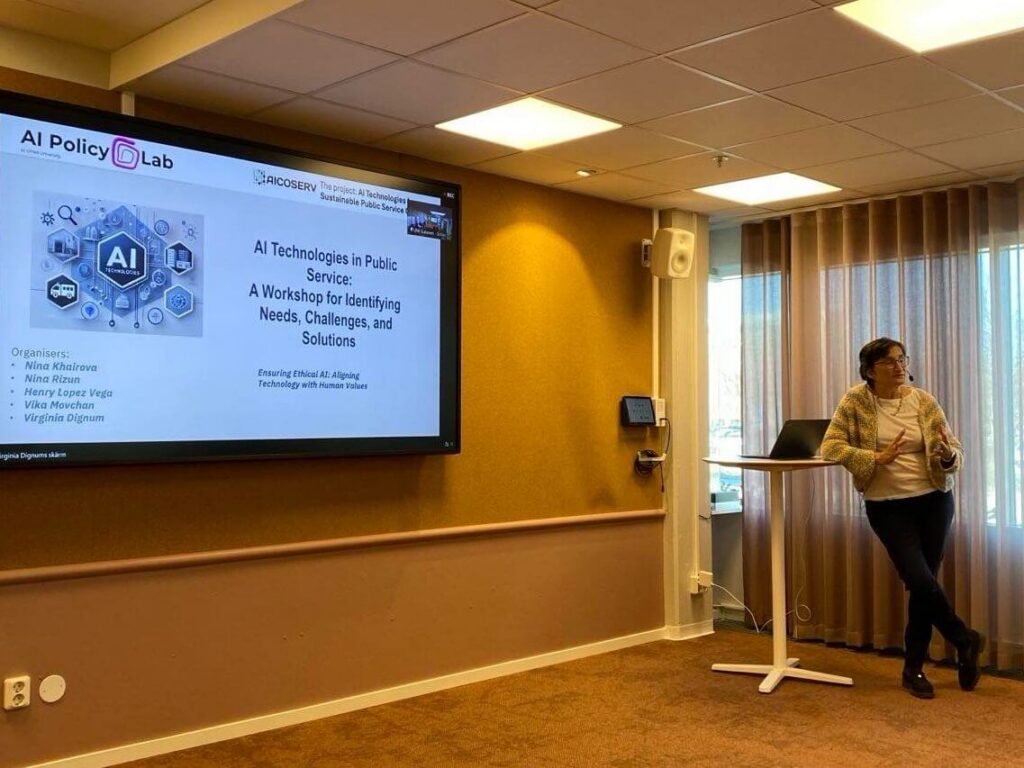
Considering the wide range of public services open to AI adoption, a recurring set of challenges consistently emerges. Whether deploying AI-driven diagnostic tools in healthcare or implementing predictive analytics within smart city infrastructures, public and private sector actors, and community stakeholders face diverse barriers. Henry Lopez-Vega, fellow at the AI Policy Lab, presented on the challenges of AI adoption in the Västerbotten region in his session titled “What are the challenges with AI (in Västerbotten)?”
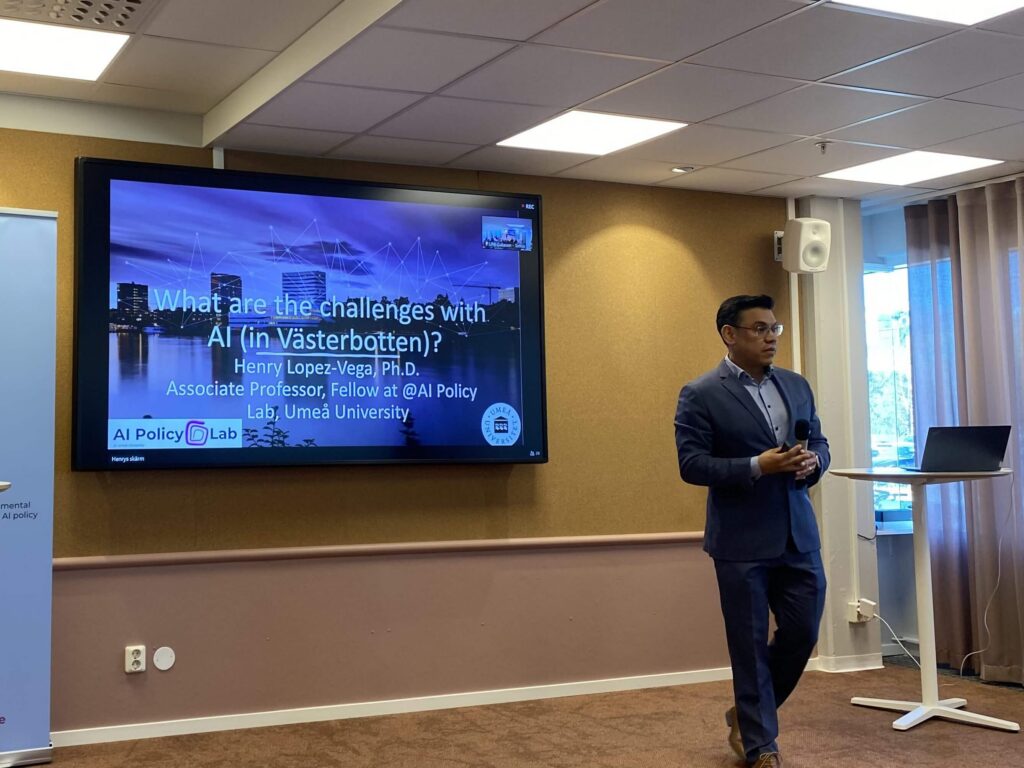
His research identified three core barriers to building a responsible AI ecosystem:
In the second half of the workshop, participants engaged in group discussions focusing on organisational challenges, key stakeholders, and barriers to implementation. Each group then mapped the skills and knowledge needed for responsible AI adoption in their contexts.
For example, in the case of AI-supported recruitment processes, participants identified several critical barriers:
To address these issues, participants emphasized the need for professionals with a blend of competences, including:
The increasing efforts to implement AI across various public sector domains have led to a critical question: what types of professionals, equipped with what specific skills and competences, should lead the integration of responsible AI? Defining the essential set of skills, knowledge, and professional competences required for the effective and ethical deployment of AI in both public and private sector services becomes a key priority.
A key outcome of the workshop was the identification of a recurring set of challenges affecting. These include:
To address these challenges, we propose the conceptual framework depicted in Figure 1. This framework highlights the urgent need to cultivate professionals who combine technical expertise, ethical sensitivity, and domain-specific knowledge to lead responsible AI integration. It maps the interconnected layers that influence the deployment and responsible use of AI technologies in public services, including:
This framework is intended to guide structured reflection and planning around AI deployment, helping ensure that technologies are not only functional but also trustworthy, inclusive, and aligned with public values. As such, it can serve as a practical tool for organisations seeking to integrate AI technologies responsibly. It encourages a systemic perspective, one that moves beyond technical feasibility to consider broader organisational, social, and ethical dimensions.
By applying this framework, decision-makers and project leads can:

Figure 1. The framework summarising the workshop’s thematic discussions
In conclusion, the workshop underscored that a stakeholder-oriented, challenge-driven approach is key to enabling responsible AI adoption. By starting with specific domain needs and mapping corresponding skills and knowledge, organisations can more effectively navigate the complex landscape of AI integration.
Jason Tucker (Researcher, Institute for Futures Studies, Sweden. Adjunct Associate Professor, AI Policy Lab, Department of Computing Science, Umeå University)


Published on 14 May 2025
Adapted from a presentation given at the NATO Science for Peace and Security Programme, Advanced Research Workshop “Clicking the Pause: The Role of Transatlantic Cooperation in AI Supervision”, Salamanca, Spain, 8-9 May 2025.
As AI becomes increasingly embedded in critical societal functions, the need for robust, internationally coordinated governance grows more urgent. While some national and regional regulation of AI is emerging, applications in defence and international security often remain exempt from these initiatives. This historical separation between civil and defence sectors is understandable given the unique operational requirements of the military. However, it risks creating a false dichotomy—suggesting that AI use in civil domains is largely divorced from international security concerns. However, the geopolitical implications of AI in the civil sector are profound and escalating (Schaake, 2024).
To illustrate this, healthcare provides a concrete and urgent example. Across NATO members and partners, localized and largely disconnected decisions are being made to adopt small-scale AI solutions in healthcare. With states having limited capacity to develop in-house solutions, they often turn to external actors. Doing so means that they are then subject to a complex and opaque web of global supply chains and international actors. This poses substantial risks, including vulnerabilities to cyber-attacks, dependencies on potentially hostile states or corporations, and strain on critical infrastructure to support its adoption.
The growing instability of the international order compounds these challenges. The United States has recently exhibited unpredictability in both its Administration and its corporate tech sector. Even if diplomatic relations are maintained, trust at the local level is harder to rebuild. Working with partners whose long-term reliability is in question introduces significant risk, and other non-traditional partners become more appealing. Where these actors are not aligned with NATO, this could be a vulnerability.
Moreover, the adoption of AI in the civil sector has been driven by techno-solutionism — the prioritisation of technological fixes that neglects broader societal and security trade-offs, as well as potentially more appropriate non-technical solutions. It glosses over the reality that AI, as a socio-technical system is embedded in cultural, institutional, and ethical contexts and requires participation from a broad range of actors to function at its best.
Healthcare systems are particularly susceptible to this narrative (Strange and Tucker, 2024). They face resource constraints that limit the capacity to develop, implement, and secure AI technologies. Combined with the dominant discourse being that AI is the only and best way to solve a broad range of healthcare issues, everyday actors in healthcare are facing pressure to adopt AI where they can. At the same time, NATO’s security infrastructure is drawing from the same limited resource pool—particularly in terms of skills, energy, data infrastructure, and cybersecurity capacity. Without careful coordination, this could lead to a zero-sum scenario, undermining societal resilience and military advantage.
Cybersecurity threats to healthcare are well documented. The World Health Organization has recognized that cyber-attacks targeting health systems have considerable consequences in terms of public health and international security (WHO, 2024). In 2021, WHO reported that one-third of global healthcare institutions had suffered at least one ransomware attack in the preceding year (Mishra, 2024). The European Union reported that in 2023, healthcare was the most targeted critical sector in cyber-attacks (WHO, 2024). During the COVID-19 pandemic, healthcare was not just a target but a vector for disinformation and destabilisation by state and non-state actors alike. Given these risks, decisions about AI adoption in critical civil sectors like healthcare cannot be made in isolation from geopolitical and security considerations. Yet most local actors are not equipped to understand or navigate these complex dynamics. The absence of coherent guidance or frameworks linking AI adoption to national and international security exacerbates vulnerability, weakens societal resilience, and increases dependence on untrustworthy partners.
Global AI governance is essential. It can establish the guardrails necessary to manage these risks and guide responsible adoption of AI technologies across sectors. NATO has a critical role to play here. By integrating civil sector AI governance into its strategic thinking, and engaging with the Allies on this, NATO can help ensure that AI adoption enhances—not undermines—resilience and collective security. This will allow for a more realistic assessment of the trade-offs involved in AI adoption, especially in sectors like healthcare that are both vital to public well-being, are particularly vulnerable to attack and a conduit for hostile actors to cause societal disruption. NATO’s role here should be seen as complementing other international AI governance efforts, such as those by UNESCO, OECD and the EU etc. This would ensure that these governance structures do not become dominated by military priorities and bridge the gap between the defense and civil sector. Democratic safeguards, such as civil society oversight or public reporting, for any NATO-related initiatives affecting the civil sector, would also be essential. As would multidimensional and multidisciplinary views on civil resiliency frameworks.
AI in the civil sector is not a technical or administrative matter alone—it is a strategic issue with implications for the stability, security, and cohesion of NATO members’ and partners’ societies. Only through coordinated, international governance, can we navigate this new terrain with the prudence and foresight it demands.
References
Mishra, V., (2024) Cyberattacks on healthcare: A global threat that can’t be ignored, UN News, https://news.un.org/en/story/2024/11/1156751.
World Health Organization., (2024), Ransomware Attacks on Healthcare Sector ‘Pose a Direct and Systemic Risk to Global Public Health and Security’, Executive Tells Security Council, https://press.un.org/en/2024/sc15891.doc.htm.
Schaake, M., (2024). The Tech Coup. Princeton University Press.
Strange, M. and Tucker, J., 2024. Global governance and the normalization of artificial intelligence as ‘good’ for human health. AI & SOCIETY, 39(6), pp.2667-2676.
Further Information
This article is part of the Politics of AI & Health: From Snake Oil to Social Good funded by The Wallenberg AI, Autonomous Systems and Software Program – Humanity and Society (WASP-HS).
Keywords (comma separated):
NATO, Civil Sector, Artificial Intelligence, Security, Healthcare, Governance
Related URL (if any):
How to cite this article:
Tucker J. (2025). Civil Sector Vulnerabilities and NATO’s Strategic Role: The Case for International AI Governance. AI Policy Exchange Forum (AIPEX). https://doi.org/10.63439/UJML2174
AI Policy Lab Fellowship Information Session with Virginia Dignum
Date: May 6, 2025
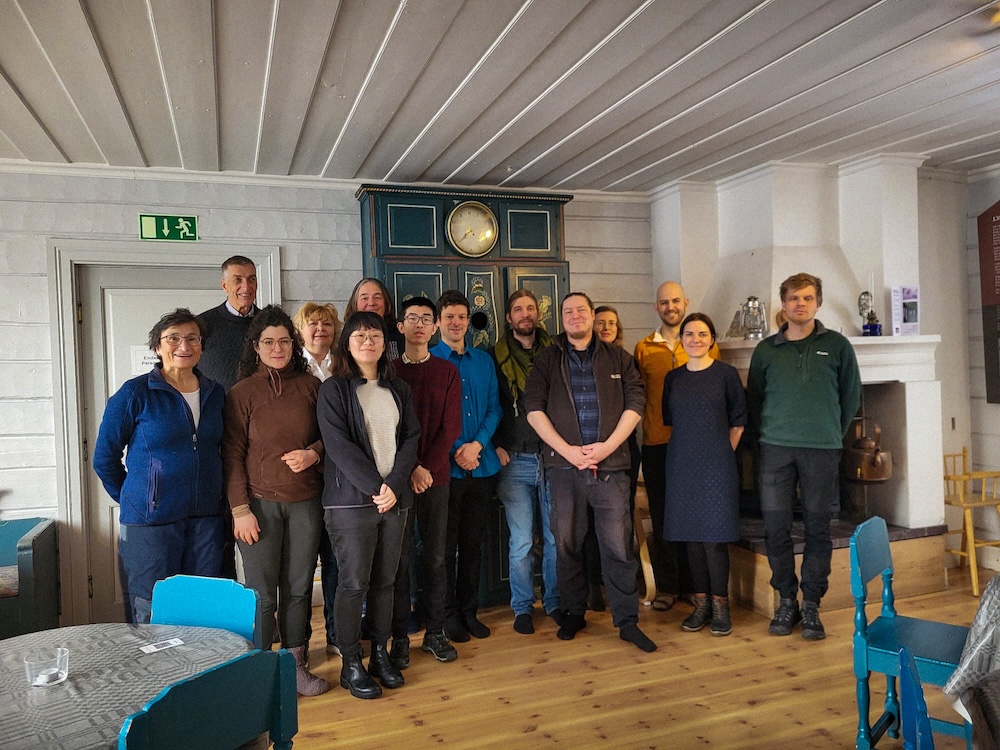
On March 17-20, 2025 at Lövånger, AI Policy Lab (AIPL), Responsible AI group and Research Group for Socially Aware AI had a 3.5-day retreat with 15 participants from both units and Francien Dechesne from Leiden University, Netherlands.
Participants discussed responsible AI from multiple perspectives – technological, ethical, and social. Below we share the key messages from the retreat. We hope to inspire future multidisciplinary discussions, workshops and projects related to responsible AI research, literacy, and practical solutions for diverse stakeholders in Sweden and internationally.
When we hear about new AI ventures, we need to ask the question zero: “Is the adoption of an AI tool the best solution for our current problem?” with assessments including the environmental costs of running this AI system and understanding of what specific aspects of operations it improves. This includes critically assessing who is participating, what is the provenance and the management of data, what are the bases for modelling and design choices, how will results and impact be evaluated. AI does not happen to us, we [humans] design and/or adopt and use the AI systems.
If the ideas above resonate with you, we encourage to check out the AI Policy Lab LinkedIn page for common cooperation opportunities.
Virginia Dignum (Wallenberg Chair, Professor Responsible Artificial Intelligence, Director of AI Policy Lab at Umeå University)


Published on 8 April 2025
As artificial intelligence (AI) evolves rapidly, the urgency to govern it responsibly becomes more pressing by the day. We are standing at a pivotal moment, one where the choices we make today will shape not just technological outcomes, but also the foundations of our societies, economies, and planetary well-being.
Even as the UN and other international agencies advocate for global AI regulation, major players – particularly the US, UK, and China – seem increasingly hesitant to fully commit. While the US and UK are currently moving towards light-touch, innovation-driven approaches that prioritize industry leadership over binding rules, China leans toward a state-controlled model aligned with its national priorities. Their reluctance undermines efforts to build the effective, inclusive governance frameworks we urgently need, and may encourage others to also sideline global cooperation in favour of fragmented, self-serving strategies.
But AI governance is not optional, it is essential. It protects rights, upholds global values, and ensures long-term economic stability and sustainable innovation. Without global governance, we open the door to a race to the bottom, marked by short-term thinking, ethical shortcuts, and growing global inequality. We cannot allow geopolitical competition to derail the collective responsibility required to ensure AI serves the common good. Now is the moment to strengthen our commitment to global, values-driven governance, not to stall it. Meanwhile, AI governance shouldn’t chase every new technology, but instead follow clear principles: transparency, fairness, explainability, and accountability. These form a foundation for adaptable policy that protects rights and safety. Tools like regulatory sandboxes, public engagement, and stronger international coordination support this flexible yet high-standard approach as AI evolves.
The best competitive advantage is not ruthless speed, but wise collaboration, especially when the stakes include trust, stability, and the health of our planet. In this context, the European Union’s €200 billion investment in regulated, human-centered AI stands out. This visionary approach demonstrates how regulation can act not as a brake on innovation but as a stepping stone for it. The EU’s commitment to ethics, inclusion, and sustainability offers a powerful alternative to the more narrowly competitive models pursued by the US and China. Yet, funding alone is not enough. Investment must be accompanied by sustainable practices, equitable access, and strengthened social cohesion. Other countries—Canada, Japan, Brazil—are also making important strides. But this is not a race with a single winner. It’s a collective effort, and meaningful progress depends on a globally aligned framework that ensures AI serves all of humanity.
Still, I am deeply concerned about the growing competition to dominate the AI landscape. China, the US, and others are increasingly viewing AI as a tool of economic and military supremacy. This race risks concentrating power in a handful of nations or corporations, sidelining most of the world and worsening inequality. China, the US, and others view AI through the lens of strategic dominance. But AI is not a zero-sum game. True progress requires transparency, ethical alignment, and shared governance.
One of the greatest ethical challenges today is the erosion of human agency through opaque, unaccountable AI systems. That’s why I advocate for Earth alignment, as we introduced in a recent article in Nature Sustainability. This framework emphasizes the need for AI governance to be anchored in environmental sustainability, global justice, and societal cohesion. These goals cannot be achieved in isolation or through regional silos. They require a shared commitment to values that transcend borders, and the democratization of governance. A small group of governments and companies cannot be allowed to shape society through their control over AI development, nor solely through the lens of existential threats and geopolitical rivalry.
Responsible development requires systemic change, not just technical fixes. Ethics must be embedded from the outset, but we must do so through systemic change, not fear-mongering. This is not just a question of innovation; it’s a matter of justice. AI should not be a tool that widens global divides or undermines democracy and social cohesion. It should be a force for empowerment, equity, and resilience. That’s only possible through shared governance, transparency, and ethical alignment across all borders, including those of the most powerful players.
This is why global governance of AI is not optional, it is urgent.
Looking to the future, what excites me most about AI is its potential to empower us, not to replace us. If we govern it well, AI could become one of our most powerful tools for addressing climate change, improving healthcare and education, and advancing equity and social cohesion. But that future is not guaranteed. It depends on the choices we make now. The future of AI is not just about building smarter machines and software, it is about working together towards a wiser humanity. One that values cooperation over competition, solidarity over supremacy. One that uses AI not to dominate, but to heal and uplift.
There is no alternative: in the long run, only responsible AI will lead to innovation that truly benefits society. Anything else will not only undermine trust and human rights but will also lead to technically weaker systems and a loss of true innovation. Irresponsible AI may promise short-term advantages, but it will cost us our long-term future.
Responsible AI is not the finish line. It is the only viable path forward.
Keywords (comma separated):
AI governance, global cooperation, responsible AI, sustainability, transparency, regulation
How to cite this article:
Virginia D. (2025). Beyond the AI race: why global governance is the greatest innovation. AI Policy Exchange Forum (AIPEX). https://doi.org/10.63439/LNQA3726